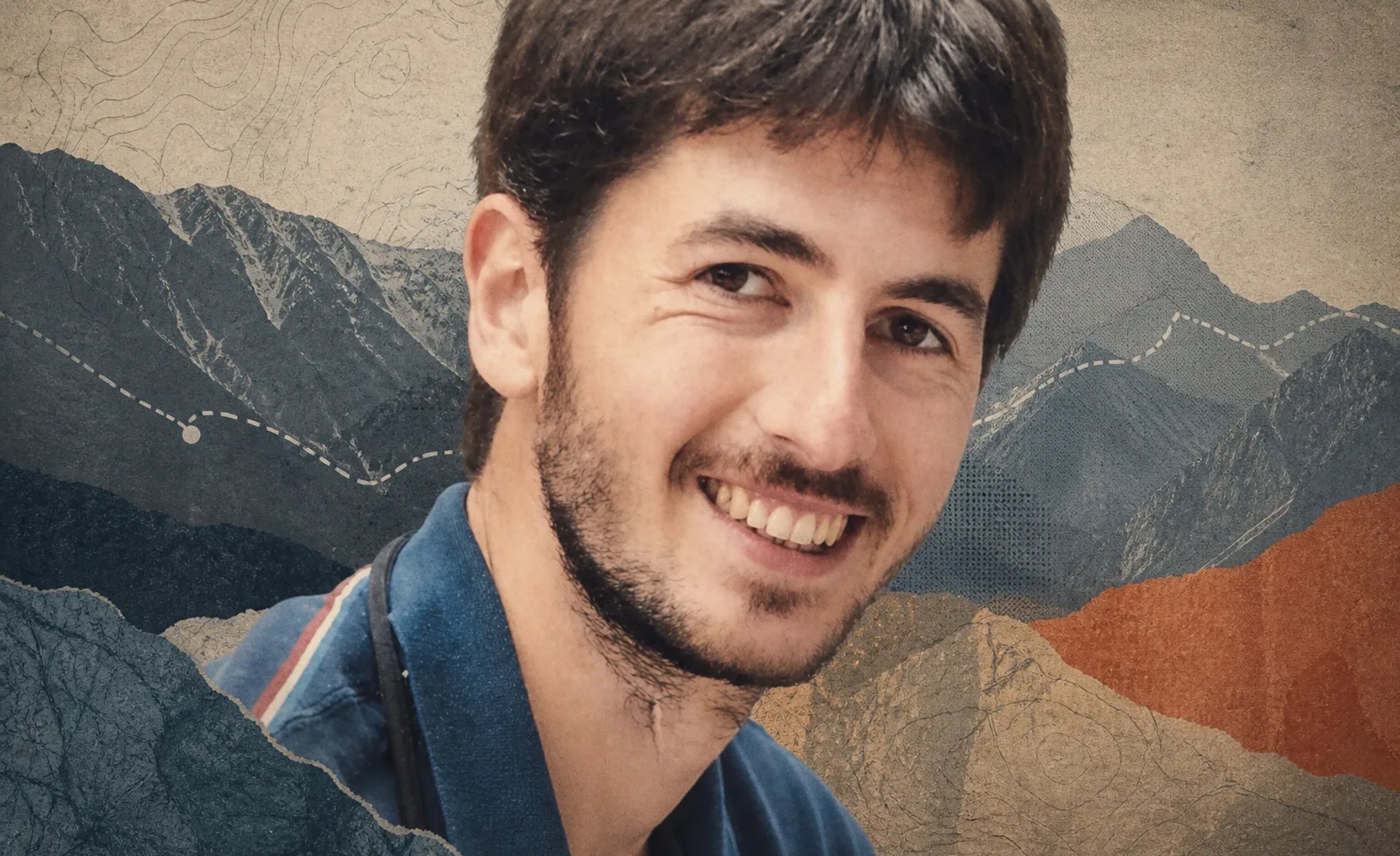


The Wanderer from Nantes
Florent Grégoire was not the kind of young man to simply slip away from those he loved. He grew up near Nantes in western France, where he'd trained and worked as a computer engineer. By his mid-twenties, however, Florent felt drawn to a different path.
He left the corporate life to become a nomadic volunteer, joining the WWOOF movement – working on organic farms in exchange for food and shelter. "He was very much turned toward others; money didn't particularly interest him. He decided to live life differently. His itinerant lifestyle completely matched his convictions," journalist Nathalie Hamon observed of Florent's ideals. Friends and family understood that he sought meaning in travel and communal living, not material gain. Florent's parents supported his quest, staying in regular contact through his travels.
By the summer of 2016, after months of volunteering in Spain, Florent set his sights on the tiny Principality of Andorra – a mountainous country wedged between France and Spain. He told his family he would spend a short time there and then return to France for an upcoming wedding of close friends. All his plans suggested he had every intention of coming home.
Pension Roser
In early September 2016, Florent checked into a modest guesthouse called Pension Roser in Escaldes-Engordany, Andorra. He was not alone. Traveling alongside him was a woman decades his senior, an Indonesian-born Australian whom Florent had met during his wanderings.
They had reportedly first crossed paths at a youth hostel sometime in late 2015 and stayed in touch. The woman, named Samba Rukmi Widhyastuti, was 55 years old – nearly thirty years older than Florent. She introduced herself as an architect pursuing a doctorate, enjoying a globe-trotting sabbatical.
It was an unlikely companionship: Florent's loved ones had never heard of this person before. In fact, none of Florent's friends or relatives even knew he was traveling with an older woman. To them, Florent had always been sociable and open, sharing stories of the people he met on the road.
The absence of any mention of this "mystery woman" was striking in hindsight. But in September 2016, Florent's family had no inkling of her existence. They only knew that Florent was due to return soon – and that he kept a routine of checking in with updates.
Into the Mountain Air
That routine came to an abrupt stop after September 12, 2016. On that day, the security camera footage at the hostel showed Florent heading out with his pack just after 12:45 pm. Where he was going, no one knew – perhaps a morning hike on one of the scenic trails above town, or to thumb a ride down the valley.
Florent never returned to the hostel. As hours turned into days, concern began to grow. Back in France, the Grégoire family's phone calls to Florent went unanswered; every ring went straight to voicemail.
Initially, these missed calls weren't panic-inducing – cell service in mountain regions can be spotty, and Florent was known to be off-grid at times. But by the end of that week, silence had stretched too long. Then, on September 20, Florent's older brother received a startling Facebook message from a stranger.
A Stranger's Concern
The message was written in English by a woman who identified herself as "a friend of Florent." She said that she and Florent had been staying together at a boarding house in Andorra when, on the morning of September 12, he "suddenly disappeared" around 9:00 am. The tone was urgent: she claimed to be worried and searching for him. This was the first anyone in Florent's family heard of Samba Widhyastuti.
Florent's mother Anita Grégoire sensed immediately that something was terribly amiss. The next day on September 21 2016 she went to the gendarmerie in La Chapelle-sur-Erdre, a suburb of Nantes to file a missing person report.
She explained to officers that she hadn't heard from her son in over two weeks – highly unusual for Florent – and now an unfamiliar woman was emailing the family with unsettling claims.
French authorities took the report seriously and reached out to their counterparts in Andorra. Soon Andorran police officers visited Pension Roser, Florent's last known location. There they found the woman who had contacted the Grégoires: Samba Widhyastuti, staying in the same lodging.
Samba portrayed herself to the Andorran officers as Florent's close friend and travel partner, worried about his whereabouts. However, from the outset her statements raised eyebrows. She spoke in English with a heavy accent, and her story of Florent's disappearance was inconsistent and riddled with odd details.
Samba claimed that on the morning of September 12, Florent had simply walked off without explanation – perhaps to go hiking – and never returned. She waited, she said, but after a day she assumed he'd gone ahead to the next stop on his journey. Strangely, Samba had not immediately alerted police or anyone else when Florent failed to come back.
In fact, prosecutors later noted that she only showed concern a full week after Florent vanished. This delay in reporting would become a key point of suspicion.
Face to Face with the Mystery Woman
Florent's parents Anita and François Grégoire did not remain passive in the face of their son's disappearance. They traveled down to Andorra themselves in late September 2016 to meet with local police and this mysterious companion. When Florent's mother and father met Samba Widhyastuti in person, they found her behavior deeply troubling.
Speaking mostly in English, the 55-year-old offered convoluted, contradictory explanations for what had happened to Florent. One moment she implied Florent might have run off with another woman; the next she mused that perhaps he had staged his own disappearance. She oscillated between acting distraught and being strangely detached.
The Grégoires, desperate for any credible lead, grew increasingly frustrated. Nothing Samba said added up. As Florent's father later recounted, "We came to find answers, but left with only more questions."
When Florent's family returned to France empty-handed, they hoped that formal investigation might succeed where their own search had failed. French gendarmes opened a case and began interviewing Florent's acquaintances, gathering communications records, and liaising with Andorran officials. Very early on, Samba Widhyastuti's role loomed large.
She was, as one investigator put it, "the last person to see Florent alive," apart from the grainy CCTV footage. If anyone knew what truly happened in Andorra, it had to be this woman. Yet Samba soon left Andorra, making herself scarce.
Back in France, as weeks turned to months, Florent remained missing and the case went cold on the ground. Andorran authorities, unaccustomed to serious crimes, conducted only a limited search of local hiking paths and then halted their efforts, apparently accepting Samba's assurances that Florent was fine somewhere abroad. "The initial investigations were painstaking," one source close to the case recalled.
"Andorra hadn't seen a murder in years, and the authorities weren't very proactive," a lapse that later weighed heavily on the inquiry. Precious time and evidence were lost in those early days.
Messages from the Dead
Even as official searches waned, strange messages continued to emanate from Samba Widhyastuti. In October 2016, Florent's parents and friends began receiving emails supposedly from Florent himself. The messages, written in English, claimed that Florent was alive and well – he had simply decided to "start a new life" and cut off regular contact.
One email suggested he had moved to the United Kingdom. These notes were full of uncharacteristic phrases that immediately struck Florent's loved ones as off. Florent, a native Frenchman, rarely wrote to his parents in English; nor would he likely disappear voluntarily without a word.
The Grégoire family's suspicions sharpened. They had already met Samba and doubted her; now it seemed someone was impersonating Florent online. French investigators dug into these communications.
Before long, a disturbing truth emerged: the supposedly cheery updates from Florent were complete fabrications. According to the family's lawyer, all those texts, emails, and social media posts "signed" by Florent had been "doctored". They were traced back to devices linked to Samba Widhyastuti.
The Prime Suspect
This revelation marked a turning point in the investigation. Samba Widhyastuti, once merely a person of interest, was now the prime suspect in Florent's disappearance. Investigators believed she had engaged in a deliberate campaign of deception: contacting the family as a "concerned friend," then later impersonating Florent himself online, all to cover up whatever fate had befallen him.
As evidence of this subterfuge mounted, French prosecutors began to suspect that Florent Grégoire had been the victim of foul play – quite possibly at the hands of the very woman claiming to care for him. Yet it was a murder case with no body and no eyewitnesses, a prosecutor would later note, making it exceptionally challenging to prove.
By 2017, with Florent still missing, French authorities issued an international warrant for Samba Widhyastuti. Efforts to locate her, however, turned up nothing for some time. Samba had apparently slipped into an itinerant life on the run.
Twenty Countries in Three Years
Using her Australian passport, she traveled through at least twenty countries over the next few years. It was as if she had become a ghost. But she could not run indefinitely.
Unknown to her, law enforcement agents in Europe were quietly tracking her movements through border databases and flight records. In late 2019, a tip came that Samba – now 64 years old – was flying from Lisbon, Portugal into Paris. French police seized the opportunity.
Arrested at Charles de Gaulle
On Thursday, November 28, 2019, as passengers disembarked a flight at Charles de Gaulle Airport, authorities moved in. Samba Rukmi Widhyastuti was arrested on the spot, ending her three-year odyssey abroad.
What investigators found in Samba's possession at the time of her arrest deepened the mystery further – and strengthened the case against her. She was carrying a trove of suspicious items: multiple identity documents under different names, an Indonesian national ID in addition to her Australian passport, five credit and debit cards, and two mobile phones. In a search of those phones, officers discovered damning digital evidence: photographs of Florent Grégoire's personal documents, including his driver's license and his bank card.
Documents in Her Phone
The images had timestamps dated days after Florent's disappearance. The implication was chilling – Samba had somehow obtained Florent's ID and bank card after he went missing, and she saw fit to photograph them, perhaps to enable her travels or financial transactions. If Florent had truly left Andorra alive and well, why would his companion be found holding onto his identification and banking information?
As one report dryly noted, Widhyastuti once told investigators that Florent had left Andorra on his own. But with Florent's documents in her hands, "how could he have left the country, as she claimed?"
The financial trail was equally suspicious. Bank records revealed that in the days just before Florent vanished, his accounts were almost completely drained – an inexplicable move for a frugal young man committed to simple living. Specifically, on September 9, 2016, three hefty cash withdrawals totaling several thousand euros had been made from Florent's account.
Those who knew Florent found this utterly out of character: he rarely kept much money at hand and had no reason to withdraw large sums. Investigators believed this money movement bore Samba's fingerprints. In their theory, Samba engineered those withdrawals, possibly coercing Florent or using his PIN, as part of a plan to exploit his funds before doing him harm.
Indeed, after Florent's disappearance, Samba proceeded to live nomadically off money that was difficult to trace, staying in hostels and budget lodgings across Europe and Asia. French police suspected she had financed her travels using Florent's stolen resources, though pinning down every transaction proved challenging. Still, these clues – the documents in her phone, the emptied bank account – formed a compelling circumstantial picture.
As Florent's family attorney, Maître Loïc Cabioch, later summarized: "First she contacts Florent's loved ones claiming to be his girlfriend and making them believe he's fine, then she goes on to use his social networks and email, posing as him… Meanwhile, his bank accounts were cleaned out just before he disappeared". For the Grégoire family, any remaining doubts about Samba Widhyastuti's involvement had evaporated. "The family has no doubt about her involvement," their lawyer said, expressing satisfaction that she had finally been apprehended.
Two days after her airport arrest in Paris, on November 30, 2019, Samba Widhyastuti was formally charged by a French judge. Initially, the charges were kidnapping and false imprisonment – reflecting prosecutors' cautious approach while Florent's fate remained unconfirmed.
Samba was placed in pre-trial detention, where she would remain for years as the complex investigation continued.
"Bogged Down in Lies"
Despite the mounting evidence, she steadfastly denied any wrongdoing. In one police interview after another, Widhyastuti changed details of her story but never budged from her core claim: that she had nothing to do with Florent's disappearance. At times she insinuated that Florent had simply left her and run off.
Other times she cast herself as the victim, alleging Florent stole her belongings – a laptop, even her passport – when he supposedly left. Investigators noted how her accounts shifted repeatedly, each version seeming to serve her convenience. By the time the case was ready for trial, Widhyastuti's narrative had become a tangle of contradictions and demonstrable lies.
"She got herself bogged down in lies, denial and manipulations," asserted French prosecutor Claire Loumadine in her assessment of the accused.
It took until 2023 for French authorities to upgrade the charges to murder, reflecting their confidence that Florent Grégoire was no longer alive. Without a body or confession, this was a bold move. But the prosecutor's office in Nantes felt the circumstantial evidence was strong and that Florent's family deserved a chance at justice.
Murder Without a Body
The case proceeded to the Cour d'assises – France's jury court for serious felonies – in Loire-Atlantique, the department encompassing Nantes. Samba Rukmi Widhyastuti's trial opened on September 22, 2025, in the Palais de Justice of Nantes, nine years after Florent's disappearance. By then 64 years old, Widhyastuti cut an unusual figure in the dock: a slight, grey-haired woman who insisted on highlighting her own pedigree and supposed victimhood.
From the outset, she attempted to recast her life story for the jury. Speaking through an interpreter (English to French), she described herself as coming from a "very good family" in Indonesia and claimed to be a distinguished architect by profession. She even alleged that she had "lived for a long time under threat," asserting that two of her ex-partners had tried to kill her in the past.
In her view, this entire prosecution was nothing but a conspiracy against her – though she struggled to explain why anyone would frame her. The judge and jurors listened impassively as Widhyastuti delivered these dramatic pronouncements. If her aim was to gain sympathy or sow doubt, it faced an uphill battle against the concrete facts the prosecution marshaled.
Over the course of four days, the court heard testimony from investigators, Florent's family and friends, and even a former boyfriend of Widhyastuti's. That ex-partner, an Australian man who had lived with Samba for two years, painted a disturbing portrait of her character. He described Samba Widhyastuti as a master manipulator and "a dangerous woman," recounting how she could turn explosively violent when angered.
"A Dangerous Woman"
"We have in the case file the notion that each time a man wanted to distance himself from Samba, she was very violent in words and deeds," explained Maître Cabioch, the lawyer for Florent's parents, summarising the pattern revealed in witness statements. The implication was clear: when Florent Grégoire possibly tried to part ways or didn't give her what she wanted, Samba's reaction may have been deadly. This testimony echoed what Florent's friend Alexandre had experienced back in 2016.
Alexandre had received a series of odd text messages from Samba after Florent went missing. When Alexandre cautiously pressed her for more information, Samba unexpectedly lashed out in anger. She disparaged Florent's character viciously, claiming he was unfaithful, that he had stolen her computer and passport, even calling Florent – the man she initially described as a dear friend – a "psychopath".
These outbursts, coming from the one person who supposedly cared for Florent in Andorra, were difficult to reconcile with any notion of innocence.
At trial, the prosecution walked the jury through the web of lies Widhyastuti had woven. They presented forensic analysis of the digital evidence tying those communications to Widhyastuti. They detailed the timeline of bank withdrawals and travel records that pointed to her benefiting from Florent's disappearance.
And though no physical remains had been found, the prosecutors argued that the totality of evidence led to one inescapable conclusion: Florent Grégoire was dead, and Samba Widhyastuti was responsible for his death. "It is an extremely difficult task you are asked to do – to judge a murder without a body and without confessions," Prosecutor Claire Loumadine acknowledged in her closing argument. She readily admitted the case had its gaps and uncertainties.
But, Loumadine continued, all plausible alternatives had been ruled out. Florent did not kill himself and vanish – there was no evidence of suicidal intent, and no body despite extensive checks of travel records and social networks. Nor did he voluntarily disappear – he left behind his passport and never accessed his bank accounts again after September 2016.
The only logical explanation, the prosecutor argued, was that Florent met with foul play at the hands of the one person who stood to gain from his disappearance. "There is one single and unique culprit," she declared, urging the jury to see through Widhyastuti's smokescreen of lies.
The defence, led by attorney Simon Despierre, tried to counter that the case was "filled with hypotheses and uncertainties". Yes, his client had lied, Despierre conceded – she had given "explanations most certainly unbearable to hear for the loved ones" waiting for truth. But spinning lies does not equal committing murder, he argued.
The defence posited that perhaps Florent really did decide to disappear or had some accident for which no evidence remained. Despierre portrayed Samba Widhyastuti not as a scheming killer but as a flawed, panicked woman who lied out of fear. He reminded the court that no forensic evidence – no blood, no DNA, no eyewitness – directly tied Widhyastuti to a violent act.
"She is not the calculating criminal the prosecution makes her out to be," Despierre insisted. It was a classic reasonable-doubt strategy, and observers noted that Widhyastuti often shook her head or wept softly during the prosecutor's narrative, as if wounded by the accusations. Still, she refused to provide any alternative explanation for Florent's fate.
When pressed on the stand, Samba stuck to wholesale denials. She could not explain the photos of Florent's IDs on her phone, except to suggest they once planned to travel and she kept copies – a story that convinced no one. She had no convincing answer for the emptied bank account.
And she dismissed the testimony of her ex-partner as lies, even as the consistency of his account with her documented behavior was apparent.
Twenty Years
After five days of hearings, the jurors in Nantes retired to decide the fate of this grandmotherly defendant, for a murder that left virtually no trace. Seven hours later, the court reconvened to announce its verdict.
Samba Rukmi Widhyastuti was found guilty of the murder of Florent Grégoire. As the presiding judge read the decision, Widhyastuti closed her eyes and bowed her head. The Grégoire family members in attendance – Florent's parents and siblings – held hands tightly.
There was no joy in that moment, only relief mingled with sorrow. The court sentenced Widhyastuti to 20 years of incarceration for the murder. This was the exact term the prosecution had requested, reflecting the gravity of taking Florent's life and the deceit that followed.
Considering her age, it was as severe a punishment as the law could realistically impose short of life imprisonment. Moreover, the court attached additional penalties: upon release, Widhyastuti would be permanently expelled from French territory, and she was barred from owning firearms – standard measures in France for serious violent offenders. She was also ordered to pay tens of thousands of euros in damages to Florent Grégoire's family, compensation for their suffering and the loss of their son.
As the verdict was delivered, Florent's mother Anita quietly wiped away tears. They still did not know where Florent's body was or how exactly he died, but after nine agonizing years they at last had official recognition of his fate and his killer's responsibility.
Outside the courtroom, Maître Cabioch spoke to reporters on the family's behalf. "We had hoped for the truth about what happened to Florent," he said, "but only Widhyastuti knows that." Indeed, even the verdict could not fill all the painful blanks. Florent's remains have never been found, and Widhyastuti has never confessed nor revealed a single detail of the supposed crime.
In the absence of a body, the Grégoire family's grieving process remains suspended, in a way. They cannot hold a proper burial or know the place where their son's life was taken. What they do have now is a measure of justice and the validation that their suspicions and tenacity were not in vain.
Yet the case of Florent Grégoire is not entirely closed. Samba Widhyastuti immediately filed an appeal against her conviction. Under French law, a murder conviction by a Cour d'assises is automatically eligible for a retrial upon appeal, meaning the entire case will be heard all over again by a new jury in a higher court.
As of late 2025, preparations for this second trial are underway. For Florent's family, it means more waiting and the reopening of wounds they have tried hard to heal. Nonetheless, they are resolved to see the process through one more time.
They want the verdict reaffirmed – and if possible, they still cling to hope that Samba Widhyastuti might one day tell them what truly happened in those Andorran mountains.
A Garden in Treillières
Florent Grégoire would have turned 38 this year. In Treillières, the village of his upbringing, the Grégoires keep a small garden in his memory, a quiet spot where they sometimes speak to their missing son in thoughts and prayers. They remember a kind, gentle soul who sought only adventure and human connection, and who crossed paths with a predatory individual he never fully understood.
The case of the vanished backpacker stands as a stark reminder of how even the most tranquil of places – a peaceful hostel in the Pyrenees – can harbor danger. It took nearly a decade, but the relentless efforts of Florent's family and investigators ensured that the voices of the dead and missing were finally heard.
Primary reporting and references
- Gir al cas del jove francès desaparegut a Andorra el 2016
AraOct 21, 2023
- French court jails Australian woman for murder
Le MondeSep 27, 2025
- Nou judici pel crim del francès desaparegut a Andorra
Related episodes

The DNA Breakthrough
A terrified emergency call after a car crash launches a decades-long hunt for Élodie Kulik's killer.

The Emilie Meng Murder Solved
A teenager vanishes after leaving a train, and a second abduction cracks the case seven years later.

What Happened to Jasmina
A missing woman's family claims she moved abroad until her body is found much closer to home.