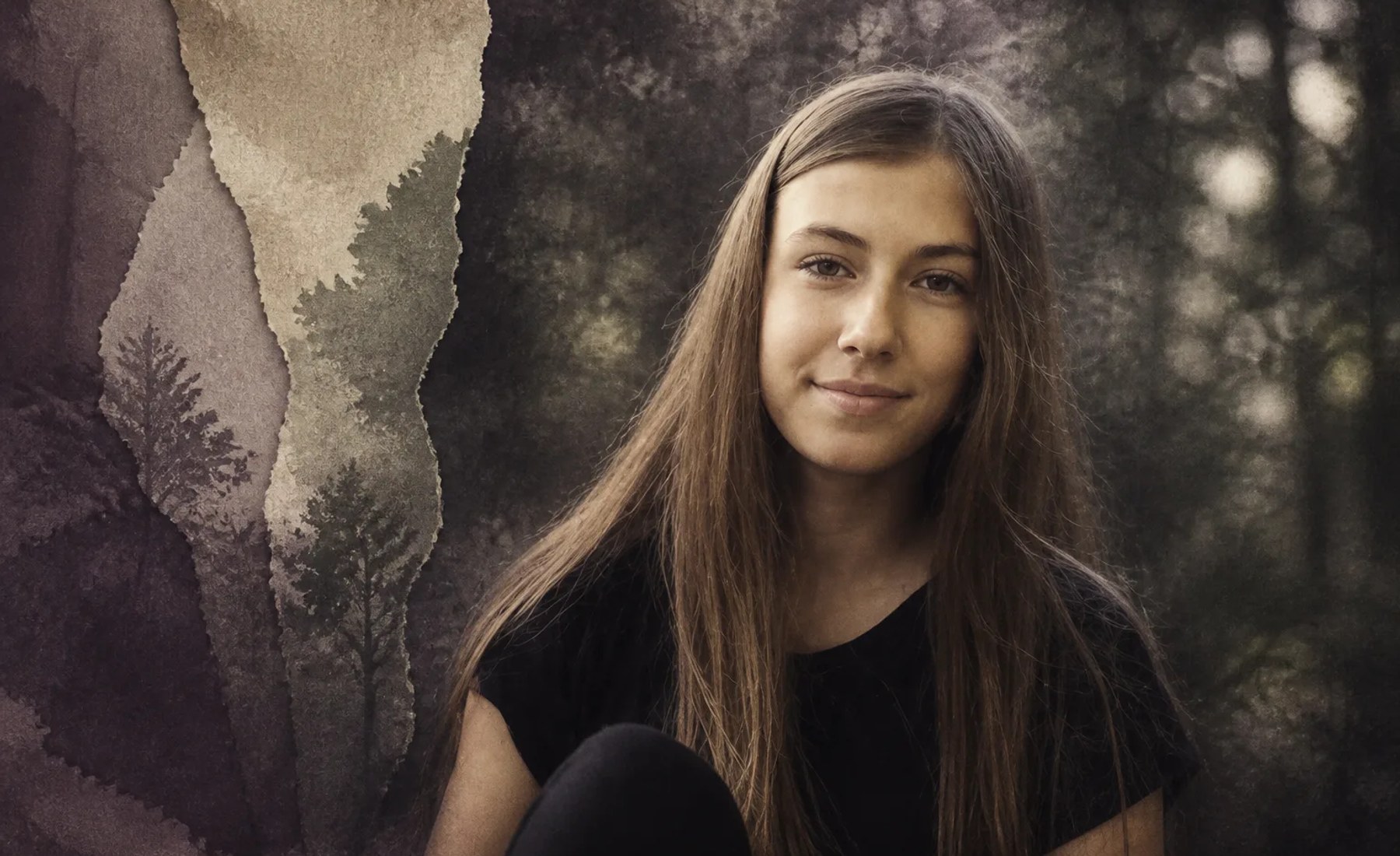


The Girl Who Sang in Church
Emilie Meng lived in Korsør, a quiet town on the western coast of Zealand, Denmark's largest island. She was a student, a churchgoer, and a talented singer preparing for a performance that very morning.
Her parents described her as responsible and mature — the last person who would simply vanish without explanation.
When she didn't arrive home and then didn't show up at church, her mother contacted police. The initial response was frustratingly slow. Officers suspected Emilie might have run away, despite her family's insistence that she would never do such a thing.
This early misjudgment would cost precious time in the investigation.
A Town Holds Its Breath
By the next day, as Emilie remains missing with no contact, the reality sets in – something terrible may have happened. South Zealand and Lolland-Falster Police (the regional force) launch a search as Emilie's distraught family pleads for help.
Over the following days, volunteers join police in scouring Korsør and the surrounding area . Search parties sweep through town on foot and horseback.
Her smiling face is soon papered on missing posters across the entire country . Tips pour in from all corners; over the next six months, there are dozens of supposed sightings of Emilie, not just in Denmark but across Europe .
Perhaps she'd been spotted at a train station in Germany, or seen traveling with a young man in Sweden – the rumors fly, offering slivers of hope that she might be out there somewhere. None of these leads pan out . Emilie's loved ones ride an emotional rollercoaster, trying to stay optimistic but fearing the worst with each passing day.
Korsør, a town of just 14,000, is gripped by anxiety and dark speculation.
From the outset, police chase down every possible angle. They interview Emilie's friends who were with her that night – the girls recount how they offered her a ride, but she insisted on walking the short distance home . Investigators retrace Emilie's likely walking route from the station.
It was a path she'd taken before – a footpath leading around a little lake and through a park. They search in vain for any witnesses who had seen her there.
The Phantom Hyundai
As the investigation deepened, a few eerie clues emerged.
One of the first breaks came from technology: CCTV at the train station. Initially, police said there was no useful surveillance footage – a frustrating setback. But by June 2017, nearly a year later, technicians had performed an extensive enhancement of a grainy camera recording .
The footage, taken by a security camera in an indoor corridor at Korsør Station, happened to catch a glimpse out into the parking lot in the top corner of the frame . In that faint reflection, at around 4:07 AM on July 10th, a light-colored car can be seen driving slowly around the lot . The image quality was poor – just a blurry shape – but it was something.
After months of analysis (even sending the video to specialists abroad), an expert concluded with high confidence that the vehicle was a Hyundai i30 hatchback, model year between 2011 and 2016 . This was potentially huge: perhaps the car belonged to whoever took Emilie. Investigators cross-referenced every registered Hyundai i30 in Denmark, and they painstakingly matched phone records to vehicle owners, seeking anyone whose mobile phone had pinged in Korsør around 4 AM and then perhaps later near the presumed crime scene .
It was a herculean data-mining task – by mid-2017 police had interrogated around 650 people, written close to 2,000 reports, and compared roughly 400,000 vehicles against telecom data . All that work, yet still no prime suspect emerged from the blur of that phantom car. The Hyundai lead would linger for years without resolution… until much later.
False Leads and Dead Ends
In those early months, investigators also pursued more traditional leads. Multiple people of interest were questioned due to tips from the public . Three particular suspects drew attention.
One was a 33-year-old long-haul truck driver, another a 67-year-old local man whose behavior or history raised eyebrows . Police even searched that older man's house five separate times, clearly suspecting he might be involved . Yet nothing incriminating was found; ultimately, both he and the truck driver were cleared of any involvement .
These false leads fueled frustration. With each dead end, the mystery deepened: How could a teenage girl simply vanish into the night without leaving a trace of her abductor?
As summer turned to fall with no sign of Emilie, hope began to wane. By October 2016 – four months in – investigators publicly acknowledged they had three main theories: either Emilie had willingly left to start a new life elsewhere, suffered an accident, or been the victim of a crime . Privately, most feared the third scenario.
Denmark's Largest Search
The community refused to give up. In mid-September, more than two months after she went missing, volunteers organized the largest coordinated search in Danish history for a missing person . On a Sunday morning, about 70 divers and 30 mounted volunteers on horseback descended on Korsør Harbor and the adjacent fjord .
Ordinary citizens – "Mr. and Mrs. Denmark" as organizers put it – used their free day to look for any sign of the girl .
"Even if you can only help for an hour, it means so much," urged one of the search leaders over local radio. The response was heartening: dive teams, drone pilots, even Copenhagen's Fire Department dive unit joined the effort . They combed through water, mud, reeds, forests.
Companies donated snacks; volunteers baked cakes. Emilie's family, watching this massive turnout, expressed deep gratitude for the country's support . Yet despite this extraordinary mobilization – and a thorough sweep of the areas around Korsør – no new clues were found .
It was as if Emilie had vanished into thin air.
Christmas Eve at Regnemarks Bakke
Then came a devastating discovery on the very day Danes typically celebrate Christmas. December 24, 2016 – Christmas Eve morning. Nearly six months since Emilie was last seen alive.
In a marshy, remote lake called Regnemarks Bakke near the village of Borup, two people out for a walk stumble upon something horrifying on the water's edge. It's the badly decomposed body of a young woman . Police are called immediately and cordon off the area.
That evening – as families across Denmark gather for holiday dinners – the police hold a press conference confirming everyone's worst fear: Emilie Meng is dead, the victim of a very serious crime . The location of the grim find shocks investigators. Borup is about 60 kilometers (37 miles) from Korsør Station where Emilie vanished .
Her remains were in a lake near a desolate stretch of road, far from anywhere Emilie herself would ever have gone. The killer had clearly gone to great lengths to hide her body. Now, tragically, the long search was over – and a murder investigation could truly begin.
Candlelight at the Station
For Emilie's family, the news was shattering. Yet amid their grief was a sense of anguished relief to have some closure. On December 26, despite the holiday, hundreds of townspeople gathered at Korsør Station for a candlelight memorial vigil .
They laid flowers, lit candles, and shared tears in the very spot where Emilie was last seen. The Mayor of Slagelse Municipality, Stén Knuth, stood with the crowd in solidarity . Soon after, Emilie's family made a humble request: please take down the missing posters now.
Seeing their loved one's face smiling from lamp-posts and shop windows had been a sign of hope; now it was an agonizing reminder of a life lost. On January 19, 2017, Emilie Anine Skovgaard Meng was laid to rest. Her funeral at Sankt Povls Kirke in Korsør drew a huge outpouring of mourners .
The girl who loved to sing in church had a choir of sobbing voices to bid her goodbye.
The autopsy confirmed what everyone feared: Emilie had been murdered. Specifically, she died by strangulation . Due to the condition of her remains after so many months, certain details were difficult to determine.
Later leaks from the case file revealed that packaging tape was found on her face. The public wasn't told of this at the time, but one thing was clear: Emilie had met a violent end.
This was now a homicide case – and one with no obvious suspects.
Detectives pivoted immediately to focus on how Emilie's body ended up at Regnemarks Bakke lake. They theorized the killer likely drove along the highway in the early hours of July 10, taking Emilie far from Korsør to dump her remains. Did anyone see or hear something that night?
In the days after Christmas 2016, police appealed for witnesses who might recall unusual activity near that lake back in July . Amazingly, an important tip did surface: a woman reported that she had seen a man lifting a heavy object by the lakeshore around the time of Emilie's disappearance . It sounded like it could have been the very moment the murderer discarded the body.
However, this tip would become a point of controversy – the witness claimed she had tried to tell police about it multiple times and felt ignored. Indeed, much later Emilie's family lawyer expressed shock that such a witness "according to her own account, reached out several times" but was not thoroughly interviewed initially . Whether due to oversight or miscommunication, this potential lead didn't immediately crack the case.
By the time it was investigated in depth, months had passed. The man with the "heavy object" remained unidentified.
"Where Are the Police?"
The Danish public, meanwhile, grew increasingly critical of the police investigation. This was a small country not used to long-unsolved murders – especially not of innocent teenage girls. Rumors swirled of police missteps.
It later emerged that early on, some surveillance footage from businesses near Korsør Station hadn't been secured in time and was automatically erased after 30 days . Vital cell phone tower data that could have pinpointed suspects' movements was incomplete or never obtained in the crucial window . Every perceived slip-up was scrutinized.
By 2019, the case had inspired a TV2 documentary bluntly titled "Where Are The Police?" , and another on DR called "An Investigation Goes Wrong." .
In one news interview, a former homicide chief acknowledged the criticism and noted that initial assumptions of a voluntary disappearance likely hampered the urgency: "Had we treated it as abduction from day one, perhaps things would be different," he conceded. For Emilie's family, these admissions were bittersweet.
They'd spent years in torturous uncertainty, clinging to hope, only to later learn that crucial evidence might have slipped through the cracks. Emilie's mother obtained a bistandsadvokat (a victim's attorney, as is customary in Denmark) to advocate for the family's interests.
That lawyer, Mai-Brit Storm Thygesen, became an outspoken voice pushing police to keep looking for Emilie's killer – and later pushing for accountability.
Despite the frustrations, investigators did not close the file. The case remained active, if unsolved. In 2021 – five years after Emilie's murder – police even took the unusual step of examining a notorious killer's vehicle on the off-chance of a connection.
They impounded a white van that had once belonged to Peter Madsen, the man who infamously murdered journalist Kim Wall in 2017 . Madsen had no known link to Emilie, but he owned property on Zealand and police wanted to leave no stone unturned; they looked for any trace of Emilie in his old van. It was a long shot that ultimately led nowhere , illustrating just how desperate the search for answers had become.
By early 2023, nearly seven years on, Emilie Meng's case was one of Denmark's most haunting unsolved mysteries – a case that many feared might never be solved. Little did anyone know, a dramatic breakthrough was looming, triggered by a new crime that would at last unmask a serial predator hiding in plain sight.
Filippa's Paper Route
On the chilly morning of April 15, 2023, in a rural village called Kirkerup about 20 km from Korsør, 13-year-old Filippa set out on her bicycle to deliver newspapers on her paper route .
It was the first weekend of Easter break, and the quiet hamlet of Kirkerup (population barely 200) was still rubbing sleep from its eyes. Around 11:45 AM, Filippa's mother grew concerned when her daughter didn't return home on time .
Filippa was typically punctual. Her mom decided to drive the paper route to look for her – and found Filippa's bicycle abandoned by the roadside, newspapers scattered. There was no sign of the girl.
Panicked, she called the police immediately. A child disappearing in broad daylight on a Saturday in a sleepy Danish village – it was every parent's nightmare, and it set off an almost instantaneous mobilization.
27 Hours of Nightmare
Within hours, South Zealand police launched a massive search operation. They weren't going to repeat the mistakes of the Emilie Meng case. Dogs, helicopters, and drones were deployed that same afternoon to scour the fields and forests around Kirkerup .
Checkpoints were set up on local roads, and officers went door-to-door asking if anyone had seen a lone girl or suspicious vehicle.
The entire country quickly became glued to the news – the disappearance of Filippa dominated headlines and TV bulletins. The urgency was palpable; even the Prime Minister, Mette Frederiksen, posted on social media, urging everyone to assist and praying for the girl's safe return .
Danes, still scarred by Emilie's unsolved case, feared the worst but hoped this time would be different.
It was. Thanks to a swift, coordinated effort – and a crucial tip from vigilant locals – the case cracked open in just 27 hours . On April 16, a day after Filippa went missing, police received a flurry of calls from area residents.
One caller had noticed something odd: a white car driving erratically near a disused property in the village of Svenstrup, not far from Kirkerup . Others provided dashcam footage from their cars that captured a glimpse of a vehicle or person of interest . Acting on these leads, officers zeroed in on a specific address – a red-brick house on the outskirts of Svenstrup.
By midday Sunday, tactical units surrounded the house. At 2:55 PM, just minutes before a scheduled press briefing, police stormed the residence. Inside, they found a scene both horrifying and miraculous: young Filippa alive, conscious – and in captivity .
She had been bound with plastic zip-ties, her mouth gagged with tape, and a pillowcase over her head . But she was alive. One can only imagine her relief as officers gently lifted her to safety, ending the nightmare.
Her overjoyed mother posted online: "27 hours of nightmare is over – my dearly beloved girl is home." A nation exhaled in unison; as a Norwegian journalist described, "A country that had held its breath for 27 hours could finally breathe out."
The "Svenstrup house" was immediately secured as a major crime scene. In one of the rooms, investigators found chilling evidence of what Filippa had endured: ligatures, ropes, strips – indications she had been restrained and likely assaulted during those 27 hours . Later it emerged that the kidnapper had even stuffed her in the trunk of his car at one point while he drove around, before bringing her to his house.
By sheer good fortune (and excellent police work), Filippa escaped the fate that befell Emilie Meng. But her rescuer's elation was tempered by what else was found in that house, on the suspect's computer and belongings – clues linking back to other crimes. Police arrested the homeowner on the spot: a 32-year-old local man.
At the time of arrest, the public knew him only as "the Korsør man" – he lived in the Korsør area – because Danish law shields a suspect's identity until conviction. That would soon change.
Word spread quickly that a suspect was in custody. People immediately began connecting dots: a young girl abducted in West Zealand, a suspect from the Korsør area, a white car… It sounded hauntingly familiar. Online, speculation exploded that this might be the break in the Emilie Meng case everyone had been awaiting.
Filippa's kidnapping was so brazen and similar in pattern – a girl snatched alone, restrained, possibly sexually assaulted – that police had to consider a connection. Internally, investigators certainly did. But officially, they stayed mum for a few days.
The 32-year-old suspect was charged with Filippa's abduction, sexual assault and attempted murder (for the extreme violence he'd used) and placed in pre-trial detention after a closed-door custody hearing .
At that hearing on April 18, he actually confessed to a portion of the crimes against Filippa – admitting to kidnapping and sexually abusing her – though he denied intending to kill her . This partial guilty plea was highly unusual, but perhaps the evidence was undeniable.
The judge kept him jailed and, citing the possibility of accomplices or further danger, imposed a name ban to prevent identifying him publicly .
Despite the gag order, the suspect's name and photos leaked onto social media almost immediately – the case was just too high-profile to contain gossip. But mainstream media continued referring to him generically.
The Man Behind the Wheel
Behind the scenes, detectives from the Emilie Meng cold case team were racing to find hard evidence tying this man to Emilie's murder. And there was plenty to check. First was the car.
When news got out that Filippa's abductor drove a white car, old memories resurfaced of that mysterious whiteish vehicle caught on CCTV in 2016.
Sure enough, investigators discovered that the suspect had owned a white Hyundai i30 back in 2016 . In fact, he had sold that car later in 2016 to a family in Eastern Europe – almost as if he wanted to get rid of it .
Remarkably, Danish police managed to track the vehicle to Slovakia and seized it for forensic examination . Think about that: seven years after the murder, they found the exact car that was likely at the crime scene. It was the same make and model the expert had flagged all those years ago.
This alone was a huge circumstantial link.
Next, the suspect's history was scrutinized. Turns out, Filippa's abduction wasn't his first suspected attack since 2016. Investigators quietly reopened an unsolved case from Sorø (another town in West Zealand).
In November 2022, a 15-year-old girl at a boarding school in Sorø had been accosted one evening on campus by an unknown man with a knife . He threatened her and tried to drag her away, but the brave teenager fought back fiercely – screaming and resisting until the assailant gave up and fled . She survived physically unharmed, and though traumatized, she gave a description: a man about 30, wearing dark clothes and a face covering, driving a light-colored car (according to some reports).
The case went cold with no suspect identified at the time. Now, in April 2023, police saw the pattern. The Sorø school was less than a half-hour drive from Korsør.
The modus operandi – target a teen girl, use a weapon, attempt to kidnap for sexual assault – mirrored both Filippa's case and presumably what happened to Emilie. On April 26, 2023, at a press conference, police dropped a bombshell: the 32-year-old suspect was now also formally charged with the 2016 murder of Emilie Meng, and the November 2022 attempted abduction in Sorø . After nearly seven years of mystery, it looked like Emilie's killer had finally been found.
The news electrified Denmark. "It was with a sigh of relief that we received the news a suspect had been charged in the Emilie Meng case," said one Korsør resident, describing how the whole town felt a weight lifting .
For the Meng family, who learned of the charge while watching the press conference live on TV in their living room, emotions ran high.
Emilie's grandmother, Lone, told reporters, "It would mean so much for the whole family if we could finally put an end to this nightmare" . They had endured so many years not knowing who or why – just knowing was itself a form of justice. Emilie's mother's lawyer, Mai-Brit Storm Thygesen, cautiously welcomed the development too.
"When police have a concrete charge, it means the investigation has momentum. It points to getting a definitive conclusion," she said, adding that identifying the perpetrator is immensely important for the family's healing .
Philip Patrick Westh
But who was this 32-year-old suspect, really? As details trickled out (once the name ban was lifted a year later, in April 2024 ), a disturbing portrait emerged. His name: Philip Patrick Westh.
Outwardly, Westh was an ordinary Danish man. He grew up locally and had no serious criminal record that anyone knew of until these crimes. In 2016, at age 25, he worked as a marketing manager – a seemingly respectable job.
Those who knew him casually were stunned. Neighbors from Korsør described him as "polite, a bit quiet." He didn't stand out as a troublemaker. After Emilie's murder, Westh carried on with life: working, dating, and doing normal things.
If he was haunted by what he'd done, nobody saw it. In retrospect, there were dark signs – just deeply hidden. By 2023, investigators found that Westh's computer was filled with child abuse materials and even handwritten stories he'd penned that fantasized about abducting and raping young girls .
It was absolutely chilling. One police source said the list of evidence seized from Westh's home ran 147 items long – including ropes, zip ties, knives, and those disturbing writings . Clearly, this was a man with a twisted psyche and a predatory fixation.
A Danish commentator noted online, "He's emotionally stunted. It's not about attraction to children per se; it's about control – dominating someone vulnerable to feel powerful." Westh had apparently struggled in adult relationships and had grown obsessed with the idea of subjugating young victims.
Remarkably, police revealed that Westh had actually been on their radar back in 2016. During the initial investigation, he was one of 1,450 individuals from whom investigators collected DNA or other information.
He would have come under scrutiny because of that white Hyundai and perhaps fit a profile.
However, technology at the time couldn't link him. The DNA sample taken from Emilie's body was too degraded and mixed (with environmental contamination) for standard labs to get a conclusive profile back then . So Philip Westh slipped through the cracks, one of many leads that went nowhere.
How agonizing that must have been in hindsight – the killer's name was likely in the case files all along . It would take advances in forensic science to change that.
Ancient DNA, Modern Justice
In 2023, as they prepared to prosecute Westh, Danish authorities quietly enlisted specialists trained in "ancient DNA" analysis – techniques normally used to sequence prehistoric bones or other highly degraded samples.
According to reports, Emilie's case became one of the first in the world where these cutting-edge methods were used in a modern criminal case . They managed to extract usable genetic clues from the old evidence. Exactly what they found remains partly confidential, but investigators strongly hinted that new DNA results were indeed obtained that could link Westh to Emilie .
It seems science finally caught up to the killer.
With the suspect identified and charged, the wheels of justice moved swiftly. The trial of Philip Patrick Westh opened on May 14, 2024, in the Court of Næstved – a stately courthouse on southern Zealand . So much was riding on this trial: not only justice for Emilie, but reassurance to a rattled public that such heinous crimes would not go unpunished.
Westh faced a staggering list of charges covering three cases: the murder of Emilie Meng in 2016 along with attempted rape and long-term deprivation of her liberty, the attempted abduction and attempted rape of the 15-year-old in Sorø in 2022, and the kidnapping, rape, and attempted murder of 13-year-old Filippa in 2023 .
In total, 36 witnesses were called to testify, from police officers and forensic experts to victims and bystanders . An extra witness – a police employee – was even added mid-trial to address some new detail that came up .
The proceedings were harrowing, as the court delved into the most graphic details of Westh's crimes. Reporters noted that some jurors and audience members struggled to maintain composure hearing what Filippa and the others endured.
From the start, Westh maintained a split defense. Through his attorney, he pleaded not guilty to all charges related to Emilie Meng and the Sorø attack, flatly denying any involvement . But regarding Filippa's case, he "partly" accepted responsibility – essentially admitting he abducted and abused her, but stopping short of admitting he intended to kill.
In court, Westh calmly described how on April 15, 2023, he had seen Filippa on her bike and impulsively acted. He knocked her off the bicycle – in fact, deliberately rammed her with his car – and when she was stunned, he forced her into his trunk at knifepoint . He confessed that he kept the 13-year-old tied up with zip-ties, rope, and even a chain, and that he gagged her with tape and a cloth bag over her head .
He admitted to sexual assaults "other than intercourse" (a legal phrasing meaning molestation or rape with objects, etc.) and to terrorizing her with threats . However, he claimed he never meant to kill Filippa – a claim belied by the fact that he was caught with a knife and had choked her at one point (thus the attempted murder charge).
He also admitted he possessed a trove of child pornography on his computer, saying little in his defense except that he had "a problem." Observers described Westh's testimony as unsettlingly detached – he described these horrific acts in a cold, matter-of-fact tone.
It was as if he viewed it all as a bad mistake, not the acts of pure evil they truly were.
Crucially, prosecutors presented the cumulative evidence linking Westh to Emilie Meng. For the first time publicly, the court heard how Emilie's body had been found with brown packing tape remnants over her mouth and jaw – tape of the same type later found in Westh's house . Experts testified that the rope and plastic ties used to bind Filippa were the same kind (and knot style) as fibers found on Emilie's remains, suggesting the same perpetrator.
And then the DNA: a forensics analyst explained how new testing methods had managed to glean a partial male DNA profile from Emilie's clothing (which had been recovered with her body). That profile matched Philip Westh's DNA, the analyst stated confidently – it was not a complete profile, but unique markers that were consistent with his, to a degree unlikely to be coincidence . Westh's defense lawyer tried to cast doubt, pointing out the DNA was degraded and possibly contaminated.
But the prosecution countered with Westh's own pattern of behavior as perhaps the strongest evidence. Modus operandi became a key theme. "The way he operated in the 13-year-old's kidnapping is clearly being seen in connection with the Emilie case," noted one investigator .
Indeed, both Emilie and Filippa were young, taken in the same region, restrained in similar fashion, and attacked by a man driving a white car. And Westh's former Hyundai, seized from Slovakia, yielded traces of what might have been blood in the trunk – too old to conclusively test, but enough to tell a story. When confronted about the car, Westh admitted he owned it but claimed he sold it simply to upgrade vehicles.
The jury wasn't buying it.
Life in Prison
After a month-long trial, on June 28, 2024, the verdict came down. The Næstved court's panel of judges and jurors unanimously found Philip Patrick Westh guilty on all counts .
As the clerk read the litany of crimes – "murder… attempted murder… rape… gross violence… illegal coercion…" – Westh stood motionless . Some in the courtroom wept quietly hearing it all laid bare. Filippa, incredibly, was in attendance with her family to see justice done .
One can only imagine the emotion as this 14-year-old girl watched her captor formally pronounced guilty, knowing she had survived and helped stop a killer.
In Denmark, which has no death penalty, the maximum sentence for such crimes is life imprisonment – a penalty reserved for only the worst offenses. The last time a life term had been given for a single murder in Denmark was the Kim Wall case in 2018, and life terms are usually quite rare. But if ever there was a case that cried out for the harshest punishment, this was it.
The court indeed imposed life in prison on Philip Westh . "He received the country's strictest sentence – life," Danish media reported, noting that the judge and jurors had no hesitation . In Danish practice, a "life" sentence technically means an indefinite term; by law the prisoner can apply for parole review after 12 years, but in serious cases many serve much longer or effectively never get out.
The expectation here is that Westh will never walk free again . He is considered far too dangerous. In fact, some speculated the Justice Ministry might use a form of preventive detention to ensure he stays locked up even if a life term were somehow commuted.
For all intents and purposes, Philip Westh will die behind bars.
Emilie's mother and siblings issued a statement through their lawyer thanking the police and prosecutors, while also urging continued reflection on how the case was handled.
The statement read in part, "We are relieved that justice has been served for Emilie. Nothing can bring her back, but knowing who did this and seeing him punished means everything to us." They also thanked the Danish public for never forgetting Emilie – for keeping her memory alive through years of uncertainty.
In the aftermath, police officials publicly acknowledged lessons learned. The South Zealand police inspector, Kim Kliver – who had led the 2023 operation – admitted that back in 2016, "We didn't have the same urgency. We thought we had more time.
We were wrong." He emphasized that after witnessing Filippa's case, they handled it differently: "The same police chief who led this investigation was determined not to let another girl lose her life, and the case was treated with utmost urgency from the start," one report noted . That commitment saved Filippa and ultimately solved Emilie's murder. In a way, it was tragically fitting that Emilie's killer was caught because he tried to strike again.
As a Danish news outlet wrote, "If he had not acted on his urge to target another young girl, he might never have been found" . In the end, his own crimes brought him down.
Philip Westh initially filed an appeal of his conviction – a formality his lawyer announced on verdict day . But a few months later, Westh withdrew his appeal, effectively accepting the life sentence . Perhaps he realized that the evidence against him was overwhelming and that no higher court would be lenient given the severity.
Or perhaps, deep down, he knows he deserves his fate. For the families of his victims, that decision was welcome. It meant no prolonged second trial and that everyone – especially young Filippa and the Sorø survivor – could avoid reliving the trauma in court again.
Emilie's Memory
Today, Emilie Meng's memory lives on in her hometown of Korsør. She would be in her twenties now, perhaps graduated from university, possibly a professional singer or teacher – all the life milestones she never got to experience.
And the question that plagued Denmark – "Who killed Emilie Meng?" – finally has an answer.
Primary reporting and references
- Drabet på Emilie Meng
Wikipedia
- Murder of Emilie Meng
Wikipedia
- Emilie Mengs familie om siktelsen
Sosialnytt
- Emilie Meng Unsolved Murder
UK Podcasts
- Største eftersøgning nogensinde efter Emilie
DRDec 28, 2016
- The study of ancient DNA is helping to solve modern crimes
The EconomistOct 23, 2024
Related episodes
Noa's Last Ride
Familial DNA finally identifies the man who murdered teenager Noa Eyal decades earlier.
The Girl on the Bike
A 12-year-old girl's disappearance begins a decades-long pursuit of justice in Norway.
Snatched from the Trail
A teenager vanishes on a forest path, leaving a mystery that DNA solves decades later.