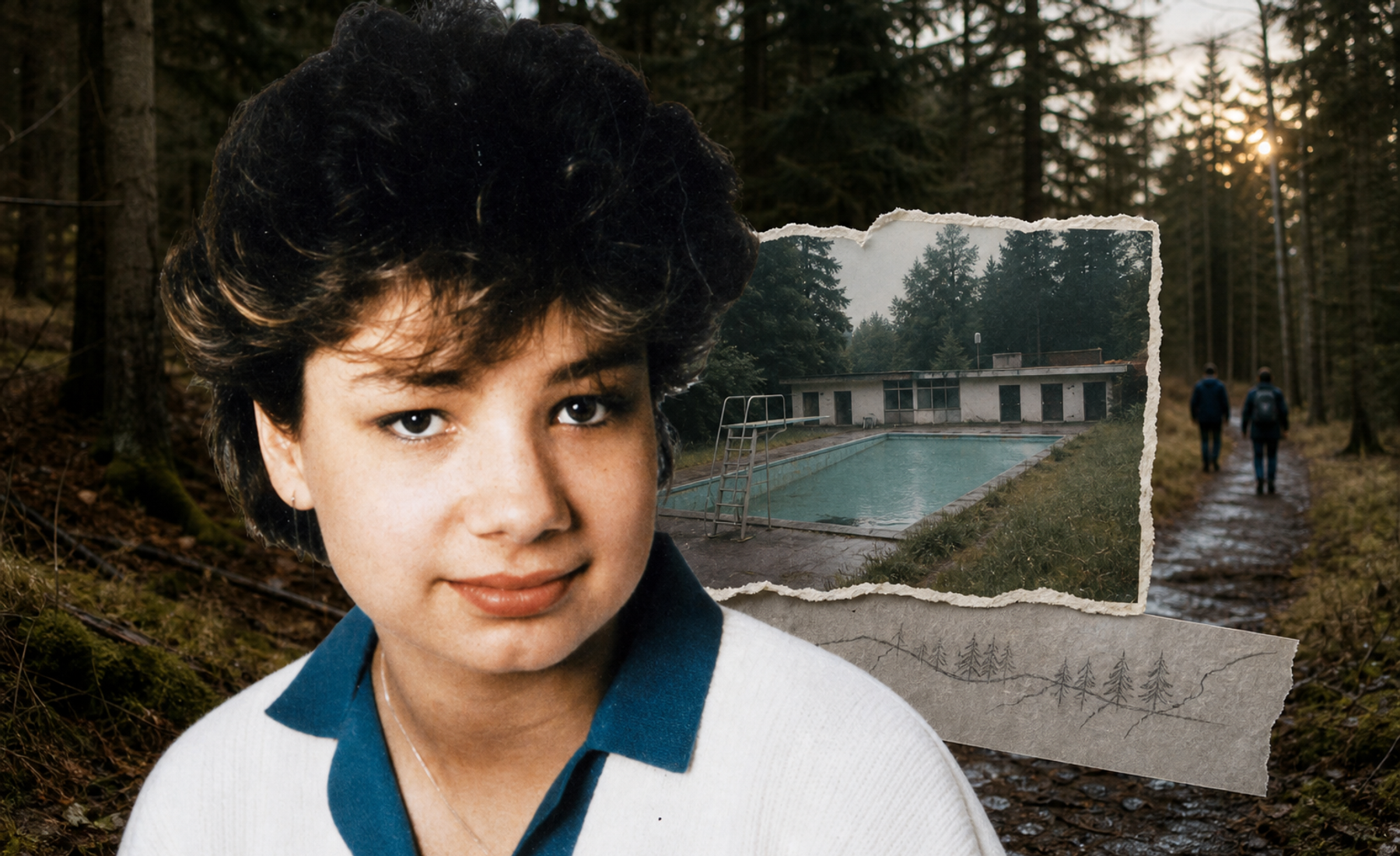


The Shortcut Through the Woods
Around 5:45 PM, Jutta says goodbye to her friends at the pool. She's eager to get home and doesn't want to stick around for the match watch-party. Slinging her white Adidas gym bag over her shoulder – it holds her towel and swimsuit – she heads out of the Freibad and onto a footpath that cuts through the woods toward town.
This footpath is the shortest route home, about 500 meters of a wooded trail connecting the pool to the Lindenfels town center. It's a path Jutta has walked many times before without any issue.
The sun is still out, and the early evening air is warm. As Jutta strolls along the dirt trail under the canopy of trees, she's likely thinking of getting home in time for dinner.
The woods around her are quiet except for her footsteps and the distant hum of television commentary filtering out of nearby houses whenever she's near the edge of the forest. Germany has come to a standstill for the soccer final, so there aren't many people out.
A Shoe on the Trail
However, Jutta isn't completely alone on that forest path. A woman walking in the area around 5:45 PM later recalls seeing two men lurking near the trail, not far from the pool.
They seemed out of place, and something about them struck the witness as odd. She couldn't pinpoint why at the time – just a gut feeling. Perhaps they were watching people pass by, or they might have been following at a distance. The witness continues on her way, not realizing the significance of what she saw.
As the clock ticks past 6:00 PM, another passerby on the same path notices something on the ground. It's a single white sneaker – a woman's shoe – lying off to the side of the trail. A few steps further, the passerby spots a woven straw mat near the bushes. These items seem oddly out of place in the middle of a woodland shortcut. The shoe and the mat will later be identified as Jutta's – likely dropped during a struggle.
A Quiet House Waits
As darkness falls and the cheers and groans of the soccer match echo through the town, Jutta's parents begin to worry. It's not like their daughter to miss her curfew or fail to call if plans change. By the time West Germany loses the game—a disappointment for the nation's fans—the Hoffmanns are living a much more personal nightmare: their daughter still hasn't come home.
When Jutta missed dinner and the evening grew late, her family's concern turned to panic. The Hoffmanns called around to Jutta's friends—had anyone seen her after the pool? They learned she left for home on foot around quarter to six. She should have been home shortly after. Something was wrong.
By nightfall, Jutta's parents phoned the police to report her missing. Without delay, local police in Lindenfels organized a search. Neighbors, friends, and officers combed the route Jutta would have taken. Flashlights bobbed in the dark as searchers walked that forest path calling her name.
Snatched
Not long into the search, they found unsettling clues: the white tennis shoe and the straw beach mat that had been spotted earlier were identified as Jutta's belongings.
They were lying beside the trail about midway between the pool and the town. The shoe's presence on its own was alarming—did she trip? Did someone grab her so suddenly that she lost a shoe? And what about the mat? Jutta would have carried that rolled up with her towel. Why was it discarded?
Finding those personal items sent a chill through the search party. It looked like Jutta might have been snatched off the path. Perhaps she was forced into a vehicle, or dragged deeper into the woods. The first witness's report of two men near the path around the same time now took on a frightening significance.
Could those men have taken Jutta? The police didn't want to jump to conclusions, but as the hours passed with no sign of the teen, an abduction seemed increasingly likely.
That night and into the next day, officers expanded the search radius. They scoured the woods, searched under bushes and in ditches, knocked on doors in the area, and set up checkpoints on nearby roads. If Jutta had been kidnapped, the perpetrators might have driven her out of town. Every passing car and stranger in the region fell under scrutiny.
In those first frantic days, however, no trace of Jutta was found beyond the items on the path. There was no ransom call, no witness who saw a car, nothing except those abandoned belongings and vague sightings of unknown men.
The community of Lindenfels was terrified. If a 15-year-old girl could vanish in broad daylight during early evening, who was safe? Parents kept their children close. Rumors swirled—was there a predator on the loose? People speculated about the two men sighted on the trail. Some wondered if they might have been workers or hikers who just happened to be there. Others feared they were a pair of opportunistic criminals lying in wait. But without solid leads, these were just dark guesses.
Police pursued every angle they could: Known sex offenders in the wider region were checked—none were obviously tied to Lindenfels that day. Jutta's family, friends, and acquaintances were interviewed for any possible enemies or suspicious encounters she'd had (she was well-liked and had no known conflicts).
Investigators even considered whether Jutta might have run away on her own—but that theory didn't fit the evidence. Why would she ditch her shoe and mat on a path if she wanted to disappear? And by all accounts, Jutta was a happy teen with plans for her summer; she had been looking forward to an upcoming judo event and a family vacation. Running away made no sense.
Into Thin Air
Days turned into weeks. The initial intensive search gradually scaled back when no new clues emerged. The forest path was combed repeatedly, but it yielded nothing more. If Jutta had been taken by force, she and the perpetrator seemed to have vanished into thin air after that struggle on the trail.
For Jutta's parents and siblings, this was the beginning of a long period of agony and uncertainty. They clung to the hope that maybe, somehow, Jutta was still alive out there. Perhaps she had been kidnapped but would be found and rescued. With no body and no answers, hope was all they had. They checked in with the police constantly, posted flyers, and reached out to media. Local newspapers ran Jutta's story and her school held prayer vigils.
As the one-year mark approached in the summer of 1987, the case was turning cold. There were no suspects, no demands for ransom, and despite a few calls from people claiming to have seen this or that, nothing panned out. It was as if the forest had swallowed Jutta whole.
The investigating officers refused to close the case—a missing 15-year-old is not something you file away lightly—but they had to admit they were at a dead end. In the absence of new information, active searches ceased. Still, the Hoffmann family and the police remained vigilant. The family kept Jutta's room exactly as it was the day she left, a silent promise that they wouldn't forget her or stop waiting for her return.
A Shallow Grave
Eighteen months passed with no resolution. Then, on February 10, 1988, a break in the silence finally came—though not the hopeful one Jutta's family had prayed for.
It was a cold Wednesday when a man walking his dog through a remote wooded area near Lindenfels noticed something unusual. In a thicket off a seldom-used dirt road in the forest, the dog had caught a scent. The man pushed aside some branches and leaves, and to his horror, found human remains. He rushed to notify the police.
Investigators arrived and quickly secured the scene. Scattered on the forest floor were skeletal remains and tattered scraps of clothing. The area was not far from the footpath where Jutta had disappeared—maybe a kilometer or two away, hidden deeper in the woods where casual passersby wouldn't normally venture. It looked like someone had attempted to bury the body in a shallow grave: the bones were partially covered with soil, decaying leaves, and branches. Time and weather had disturbed the covering, allowing the dog to sniff out the scent.
Forensic examiners carefully collected everything: the bones, remnants of fabric that appeared to be a blue dress, and what looked like a length of cloth or belt. In the makeshift grave, they also found a rusted iron spade—a shovel—lying nearby. It was of the type you'd use for gardening or digging soil. Its presence at the grave site was a strong clue that this tool had been used to dig the hole.
Although identification would require scientific verification, everyone suspected these remains were Jutta Hoffmann. The location, the clothing, and the age of the bones all matched her case. Dental records soon confirmed the worst: after a year and a half of uncertainty, Jutta's family learned that she had been murdered.
The Dress Belt
It was a devastating blow to her parents and siblings. The slim hope that Jutta might come home alive was gone. Now, at least, they could lay her to rest properly—but the question of who killed her and why loomed larger than ever. Lindenfels went into mourning. Even those who didn't know the Hoffmann family felt the loss personally; a young life had been stolen from their community.
For the police, the discovery of Jutta's body transformed the missing-person investigation into a homicide case. Important evidence came to light with the remains.
Jutta's skeletal condition indicated violent trauma. There were cut marks on some of her bones. The forensic analysis determined she had been stabbed multiple times in the chest area. The pattern of knife wounds suggested the killer attacked her viciously, possibly while she was already on the ground.
The remains of Jutta's clothing told part of the story. She had been wearing a dress that day—a light blue summer dress. Tied around the neck bones, investigators found a cloth belt from that dress, looped twice around, as if it had been used to strangle or restrain her. This chilling detail implied the murderer had tightened the dress belt around Jutta's throat, likely to immobilize or silence her during the assault.
Perhaps most tellingly, evidence pointed to sexual violence. Even though so much time had passed, the state of her clothing (which was found disturbed and partially removed) and the fact that the murderer attempted to hide the body strongly indicated that Jutta had been raped and then killed to cover up that crime. The prosecutor would later term this a "Verdeckungsmord," a murder committed to conceal another offense—in this case, rape.
The Missing Bag
When Jutta's body was discovered, one item was notably missing: her white Adidas sports bag. The distinctive white duffel bag she'd carried from the pool was not found with her remains. That raised an intriguing possibility: the killer might have taken it as a keepsake or gotten rid of it elsewhere. Its absence was a question mark—one that would become important years later.
The homicide investigation kicked into high gear. Detectives canvassed Lindenfels and surrounding areas anew. Perhaps now people would recall something useful, knowing it was indeed a murder. Old leads were revisited. The woman who saw two men on the trail back in 1986 was interviewed again.
She could only describe them in the vaguest terms (they were maybe in their twenties, one possibly with dark hair—nothing concrete enough to identify a specific person). Other locals were asked if they had seen anyone carrying a shovel or digging in the woods around the time Jutta vanished, but no clear memories surfaced.
Police also tried to trace the spade found at the grave. It was an old, generic shovel—no unique marks or serial numbers. It could have come from anyone's shed or a public tool stash. They checked if any nearby gardeners or farmers reported a missing spade around 1986, but that was a dead end.
The shovel, unfortunately, did not point to a particular suspect in 1988. And remember, this was before modern DNA forensics; at the time, the best they could do was see if there were any bits of hair, fibers, or fingerprints on it. The spade had been out in the elements for two winters, so if the killer's prints were ever on it, they were long gone.
One avenue the investigators pursued was checking records of violent offenders in the region. They pulled files on known rapists or attackers who had been active in the mid 1980s around Hesse. Perhaps a similar case had occurred elsewhere. But nothing obvious jumped out. Lindenfels wasn't known for high crime, and no similar murders of teenage girls had been reported in neighboring towns around that time.
The case of Jutta Hoffmann's murder remained perplexing. It looked like a one-off crime—a horrendous act that didn't repeat, at least not in a way that was recognized. Was it a random drifter who attacked her? Or someone local who managed to hide in plain sight afterwards? Both possibilities were considered. If it was a drifter, the person might have left town immediately and never been caught for anything else. If it was a local, perhaps he'd suppressed his urges or moved away.
34 Years of Silence
For the next several decades, Jutta Hoffmann's case remained officially unsolved. As time passed, many might have assumed it would never be solved—that whoever did it had gotten away with murder. After all, leads had dried up long ago.
The 1990s came and went; new technologies like DNA profiling started to revolutionize crime-solving, but early on, those techniques were limited and not widely applied to old evidence. By the two thousands, some cold cases in Germany were being reopened successfully thanks to DNA. Still, Jutta's case involved evidence that had been in the woods so long that traditional DNA tests in the '90s probably wouldn't have worked on it—or so it was thought.
By the mid-twenty tens, many of the original investigators had retired. Jutta's parents were aging—now in their 70s—still with no closure about who took their daughter's life. It's hard to imagine their pain, having decades of not knowing. They had held a funeral for Jutta after her body was found, and tried to move forward, but without accountability, an open wound remained.
The Spade's Secret
Then, around 2020, Jutta Hoffmann's file landed on the desk of investigators in the state of Hesse's LKA (State Criminal Police Office) Cold Case division. It had been nearly 35 years since the murder. A lot had changed in forensic science during that time.
One of the lead cold case investigators was Tanja Becker, a seasoned police inspector who specialized in revisiting unsolved homicides. Becker and her colleagues knew that sometimes the smallest overlooked detail or the application of a new lab test could crack a case wide open. They decided to take a thorough look at all the evidence from 1986–88 with modern technology.
First, they dug out the physical evidence from storage. Imagine a storeroom of a police archive: boxes labeled with case numbers, sealed bags of items from crime scenes. From the depths, the team pulled Jutta's case materials—likely still labeled with her name or a case code. Inside were the preserved remnants of that tragic day: Jutta's blue dress, the dress belt, a few plastic buttons that had come loose, perhaps some slides of hair or fiber samples, a vial of soil from the grave, and the big item—the iron spade that had been found at the burial site.
Becker later testified in court that she went item by item, systematically reviewing everything the original investigators had collected. Where 1988 forensics found nothing, 2020 forensics might. For instance, back then DNA profiling was either nonexistent or in its infancy—certainly not part of routine casework in Germany. Now, DNA technology had leaped forward. Labs could extract genetic profiles from old, even degraded biological material using advanced techniques.
One piece of evidence immediately stood out to the cold case team: that rusty spade. In 1986, the murderer likely handled that shovel with bare hands while digging the grave. He might have sweated on it or left skin cells on the handle. While fingerprints were a bust after all that time, there was a chance that the perpetrator's DNA was still present as microscopic traces on the spade's wooden handle or metal shaft.
So the spade was sent off for specialized analysis. This was a painstaking process. The lab technicians likely swabbed various parts of the spade, especially the handle grip and any nooks where biological material could have been protected from rain.
They used extremely sensitive tests to try to pick up touch DNA—tiny skin cell deposits—or perhaps old dried bodily fluids if the killer had a cut or sweat heavily. For such an old, weathered object, it wasn't guaranteed anything usable would be found. But the cold case team had nothing to lose—and everything to gain—by trying.
Around the same time, they also re-examined the clothing. The dress and belt were checked for DNA as well—maybe the killer had left hairs or saliva or sweat on them. If any of Jutta's fingernails were recovered (though unlikely given the condition of remains), those could be tested for the perpetrator's DNA too. Modern methods could sometimes get DNA from hair without roots or from bodily fluids that 80s tech would have missed. In short, this was the case's best shot at finding a genetic fingerprint of the murderer.
The investigators also had a large database of DNA profiles from convicted criminals collected over the years. If they got a DNA profile from the crime scene, they could run it through the national database to see if it matched any known offender.
Many people who commit violent crimes don't stop at one. If Jutta's killer had ever been arrested for something else in the years after 1986 and had his DNA collected, there was a chance he was in that database.
The forensic lab work likely took weeks or months—extracting decades-old DNA is meticulous and sometimes requires replicating tiny amounts of genetic material. One can imagine the cold case team anxiously awaiting the results. This case had been unsolvable for so long; the chance of a breakthrough was both exciting and daunting.
A Name in the Database
Then came the phone call they'd been hoping for: there was a DNA match. A profile lifted from the old spade's handle had hit on a known individual in the database. When Detective Becker got the news, she must have felt a jolt of adrenaline. After 34, 35 years, they finally had a name.
The man identified was a 61-year-old German male (we'll call him Peter F., as per legal custom his full surname was not initially publicized). Peter wasn't just any random citizen—he was a convicted criminal with a record of sexual offenses and violence, someone who had multiple entries on his rap sheet. In fact, at the time the DNA hit came through, Peter was not living freely in society; he was confined to a secure psychiatric facility in northern Germany.
This suspect had been born and raised in Bensheim, a town in the same region as Lindenfels. Bensheim is roughly 20 kilometers from Lindenfels—a short drive. Crucially, that meant Peter would have been familiar with the Lindenfels area. He was 24 years old in the summer of 1986, in the prime of physical strength. The profile matched multiple crime scene DNA markers directly to him. Statistically, the probability of it being someone else was astronomical.
The Tractor Rampage
Peter F. emerged as a troubled and dangerous individual. His criminal history after 1986 was telling: he had been convicted of sexual assault in the years following Jutta's murder, among other crimes. In fact, not long after 1986, he struck again (though perhaps not murder) and was caught for those subsequent crimes.
By 2012, a court in Kiel (north Germany) had found Peter guilty of attempted rape and causing grievous bodily harm. Instead of a typical prison sentence, he was deemed to have some mental disorder and was sent to a psychiatric lockup for treatment and containment.
This explains why by 2020 he was in a psychiatric institution—he'd been there for years as a detainee considered dangerous and not fully sane. In other words, Peter F. was a serial sexual predator, and his violent tendencies were severe enough that authorities had eventually taken him off the streets.
One particularly dramatic incident involving Peter happened in 2016. By that time, he was living on a farm in northern Germany (likely as part of a controlled release or work program from the psychiatric system). When officials tried to enforce some regulations on his farm regarding his cows' veterinary checks, Peter lost control. In a fit of rage, he used his tractor as a weapon, ramming and demolishing several police cars and vehicles that had come onto his property.
It took a significant police effort, including gunshots to stop the tractor, to subdue him. This made regional news—a farmer going on a rampage with a tractor is quite an event. The court held a hearing for dangerous offenders and decided Peter needed to remain confined for public safety.
These details weren't known in 1986, of course, but in retrospect they paint a portrait of a man with extreme violent tendencies and no regard for the law or others' lives. It also indicated that if he was indeed Jutta's killer, he hadn't just committed one youthful folly—he continued to harm others and escalate in different ways.
For Detective Tanja Becker and the cold case team, learning all this about the suspect was both chilling and validating. On one hand, he fit the profile of the kind of person who could have done such a crime—a young man with violent sexual impulses.
On the other hand, knowing he had been active and dangerous for years made it all the more urgent to solidify the case against him. The good news was he was already locked up, so there was no risk of him fleeing or hurting someone in the present. But to convict him of Jutta's murder, they would need to build an airtight case, especially given the passage of time.
'Aktenzeichen XY... ungelöst'
The investigators decided to use an innovative approach to strengthen their case. They arranged for Jutta's story to be featured on 'Aktenzeichen XY... ungelöst,' Germany's leading true crime television program. But this wasn't just about generating new leads from the public. The team had a more strategic goal in mind.
Working with undercover officers, they arranged for Peter to watch the broadcast in a controlled setting. The plan was to observe his reactions and listen for any comments that might reveal insider knowledge of the crime.
During the program, which detailed Jutta's disappearance and the evidence found over the decades, Peter's behavior became noticeably nervous. More importantly, in conversation with undercover officers nearby, he made several remarks about specific details of the crime that had never been made public—things only the killer would know.
These incriminating statements, combined with the DNA match and other evidence, gave investigators what they needed.
With the DNA match, the witness recollections, and now Peter's own words caught by undercover officers, the cold case team and prosecutors felt they had a strong case. Nearly 37 years after Jutta's life was taken, they were finally ready to move on the suspect.
Shortly after the TV sting, on March 30, 2023, authorities made their move. They obtained a warrant and Peter F. was formally arrested and charged with the murder of Jutta Hoffmann. In practical terms, this meant transferring him from psychiatric hold to regular pre-trial detention under murder charges, but since he was already in custody, there was no dramatic chase or handcuff scene on the street. However, for Jutta's family, the news was momentous: after nearly four decades of not knowing who killed their daughter, police told them they had a suspect—and it was someone with a track record of heinous acts.
The arrest made headlines in regional media. One newspaper exclaimed the catch with a headline equivalent to "Suspected Murderer of Jutta Hoffmann Caught!" People in Lindenfels and Bensheim were stunned. Many had probably forgotten about the case over the years, or assumed it would never be solved. Now, out of the blue, a man was being accused of the crime everyone thought was buried in the past.
Face to Face
For the Hoffmann family, this development brought a complicated mix of emotions. There was relief—finally a name and a face to the monster that haunted their nightmares. But there was also the resurgence of pain, as the arrest reopened all the old wounds. And ahead lay the challenge of a trial, where they would have to sit in the same room as the man who brutally took Jutta from them.
Peter, now in his early 60s, was reportedly unfazed by the charges—at least outwardly. When questioned by police and during preliminary hearings, he maintained his silence. He neither confessed nor made statements, which is his legal right. This stoicism or indifference—no apology, no denial even—must have been maddening for the family. Yet it was in line with his history: he'd never shown remorse for his other crimes either.
In Germany, serious crimes like murder are tried not by jury, but by a panel of judges (usually professional judges plus lay judges). Peter's case was set to be heard at the Darmstadt Landgericht (District Court) in Hesse, not far from the crime location. The trial was scheduled for late 2023, giving prosecutors time to organize all evidence and witnesses, and the defense time to prepare as well.
On November 15, 2023, the trial of the now 62-year-old Peter F. for the murder of Jutta Hoffmann commenced in Darmstadt. It was a day long awaited by Jutta's parents—who by now were in their 80s. They attended the opening of the trial, sitting in the courtroom just a few meters away from the man accused of slaughtering their child. For them, seeing Peter in the flesh was both surreal and painful. This was the first time they had ever laid eyes on him; back in 1986, he was nobody to them, just a nameless predator. Now he had a face—one that reportedly showed little emotion.
Peter was brought into court under heavy security (given his past outburst with the tractor, they weren't taking chances). He tried to hide his face from the press cameras by pulling a hood over his head as he was led in. But in the closed courtroom, everyone could see him clearly. He sat as the indictment was read: the prosecution charged him with rape and murder—specifically murder to cover up another crime (rape), which in German law is an aggravating circumstance ensuring a life sentence if convicted.
State Prosecutor Eva Heid laid out the case methodically. She described how on June 29, 1986, Peter, then 24, had been in Lindenfels. Perhaps he was trolling for a victim that day—maybe hanging around the pool or forest hoping to encounter a lone young girl. When he saw Jutta walking that path alone, he decided to act. In the prosecution's reconstruction, Peter followed Jutta down the trail.
The two witnesses who noticed men and later the shoe indicate that at some point along that short journey, Peter confronted Jutta. Perhaps he pretended to ask for directions or offered help, then suddenly grabbed her. Jutta likely tried to run or scream, which is when her shoe fell off and her mat dropped. Peter subdued her, possibly by punching or, as evidence suggests, using her own dress belt as a garrote to choke her until she passed out.
Then, in a secluded spot off the path, Peter raped Jutta—an act of utterly horrific violence, especially to a 15-year-old. After he had assaulted her, he realized she could identify him if he let her live. Plus, her cries or the evidence of the rape would lead police straight to him. So, to hide his crime, he decided to kill her. He pulled out a knife—he might have been carrying one, or perhaps he found one in that forest shed where he grabbed the spade. He stabbed Jutta repeatedly in the chest, ensuring she was dead or dying.
To further cover up, Peter then looked for a place to hide the body. He found an old small shed or hut in the woods that had tools—there he took the spade. In a rush, he dug a shallow grave right there in the forest and placed Jutta's body in it, covering it with dirt, leaves, and branches. In his haste, or perhaps callousness, he left the spade at the gravesite. (He might have planned to come back for it or figured leaving it didn't matter.)
Peter gathered up some of Jutta's personal items that were near the scene—likely her bag (which contained her ID, clothes, etc.), maybe her second shoe, and possibly other belongings like her wristwatch or jewelry if she had any. He took the white sports bag with him as he left. Whether as a trophy or to remove evidence, he ended up keeping it.
By the time darkness fell on June 29, 1986, Peter F. was driving away or walking away from Lindenfels, having committed murder. Jutta's body lay hidden in a crude grave, and it stayed hidden for 19 months.
In court, all of this was spelled out in detail by the prosecution. They backed up the narrative with the evidence gathered:
The DNA on the spade matched Peter's unique genetic profile. This alone was powerful: essentially placing his hands on the murder weapon or at least at the burial.
The cold case unit's work was presented: the re-testing of evidence with new technology, the crime lab's success in finding that DNA match, and the fact that it precisely hit on Peter, who had a history of similar crimes.
Investigator Tanja Becker took the stand, describing how she reopened the case. She recounted going through that archived evidence and what condition it was in. She specifically mentioned retrieving the blue dress, belt, button, spade, etc., from storage. She also testified about the significance of the spade and how DNA from it led to Peter. The defense struggled to counter this—the explanation of contamination was met with detailed explanations of the chain of custody and lab protocols.
An interesting revelation about Jutta's sports bag was also presented. Witnesses testified that the distinctive bag was later seen with Peter. In fact, when that white Adidas bag was shown as evidence, multiple people from Peter's side recognized it immediately as the one he had decades ago. It was a "lightbulb moment" connecting him directly to the victim. The defense found it difficult to argue an innocent reason for him to have had Jutta's bag.
The undercover officers provided testimony about Peter's incriminating statements. One of the undercover agents recounted how Peter reacted to the TV program. The officer described Peter's nervous demeanor and the specific things he said that lined up with hidden details of the crime—details never made public but which matched exactly what was found on Jutta's remains.
Additionally, the prosecution called witnesses from 1986 who still remembered key details. The friend who was with Jutta at the pool that day described her departure. The people who found the shoe and mat testified about the time and location. A former acquaintance of Peter recalled that he showed up with scratches on his arms the day after or was behaving oddly. These long-term memories gave context and credibility to the storyline of that day.
All pieces interlocked. As the chief judge noted when delivering the verdict, one clue fit into the next, painting a cohesive picture.
The defense's strategy mostly relied on casting doubt. They argued that the evidence was circumstantial. No one directly saw Peter attack Jutta. They floated alternative interpretations: maybe the DNA was somehow transferred, maybe the witnesses misremembered after so long, maybe someone else gave Peter the bag unwittingly. They also pointed out that Peter himself never confessed—he maintained, even to acquaintances, that he wasn't involved. The defense even requested an acquittal, saying the indicators could be interpreted differently and weren't absolute.
Peter's mental state also came up. The court had to determine if he was fully culpable back in 1986 or if any diminished capacity applied. Given that he ended up in psychiatric care for later crimes, the defense might have tried to argue he was insane or not in control at the time of Jutta's murder. However, an old psychiatric evaluation probably wasn't available for 1986.
In any case, the prosecution's portrayal of the crime's methodical nature—he clearly knew exactly what he was doing—suggested he knew it was wrong. The fact he evaded capture for so long implies cunning, not incapacitation.
Throughout the trial, Peter F. remained silent and showed no remorse. He never took the stand in his defense, a decision that left observers noting his cold demeanor. He offered not a single word of apology or regret to the Hoffmann family. He often sat with a stony expression, sometimes hiding behind a folder to avoid photographers. This cold demeanor did him no favors in the eyes of the judges.
The trial lasted several weeks with multiple hearings. As it drew to close in December 2023, Jutta's family sat through harrowing details of their daughter's final moments and endured being near the man accused of causing them such immense pain. They had waited 37 years for this moment of justice, and it all hinged on the judges' decision.
Life Without Parole
On December 22, 2023, the verdict was announced: Peter F. was found guilty of the rape and murder of Jutta Hoffmann. The court sentenced him to life imprisonment, which in Germany is the maximum penalty and generally means at least 15 years before any parole consideration, often much longer for severe cases. Given the gravity of this case and Peter's evident dangerousness, it's likely he will never walk free again. The judges also ordered that he remain in a secure psychiatric facility, acknowledging his ongoing issues, but importantly, this was not a case of "not guilty by insanity" – it was a clear verdict of guilt.
After the verdict, a representative for the Hoffmann family stated that there was never a second of doubt in the trial that Peter was the perpetrator. The evidence was overwhelming. The lead prosecutor commented that it wasn't just one or two hints—it was a whole chain of evidence that led inexorably to Peter's guilt.
Peter F., of course, appealed the verdict—as is his right—to the Federal Court of Justice. However, in October 2024, the high court rejected his appeal and upheld the conviction and life sentence. This made the judgment final. There would be no further technical escapes for him.
Murder Never Sleeps
The solved case of Jutta Hoffmann stands as a testament to the power of persistence in law enforcement. Thirty-seven years is a long time—an entire generation. Many cold cases never get solved, especially when so much time has elapsed. But this case shows that advancements in forensic science, coupled with determined detectives who think outside the box, can bring a killer to justice even after decades.
For Lindenfels, hearing the identity of the murderer was surprising. Peter wasn't a public suspect all those years, so he wasn't the subject of town gossip. Many locals might not even have known him if he was from Benshyme and left soon after the murder. But some older residents who remembered the case felt relief that, after so long, they finally knew the truth.
From Jutta's family's perspective, solving the case is bittersweet. On one hand, justice was done and they finally have answers. On the other hand, it brought back the pain of losing her all over again. Her mother, now in her 80s, said the trial stirred up everything they had tried to cope with over the years. No outcome, even a guilty verdict, can truly compensate for a lifetime without their daughter. But at least they saw the person responsible held accountable and punished.
Jutta Hoffmann would be 53 years old if she were alive today. Perhaps she'd have a family of her own, a career, a life filled with experiences that were brutally cut short. In the courtroom, her photo—forever 15, smiling in 1986—served as a stark reminder of the vibrant life stolen from her. The successful resolution ensures that her story is remembered not just as a tragedy, but as a triumph of justice in the end.
For law enforcement, this case is now often cited as an example of how "murder never sleeps," meaning that no matter how old a case is, it can always resurface. It's also noted for the innovative way it was solved—a combination of old-fashioned detective work, modern science, and even media engagement. At a press conference, officials credited the teamwork of forensic scientists and detectives and emphasized that the verdict sends a message to criminals: you may get away with it for years, but the truth will eventually catch up with you.
Primary reporting and references
- Mädchenmord nach XY geklärt
Securitel
- Mordfall Carmen Kampa
Wikipedia (German)
Related episodes

The Emilie Meng Murder Solved
A teenager vanishes after leaving a train, and a second abduction cracks the case seven years later.
Noa's Last Ride
Familial DNA finally identifies the man who murdered teenager Noa Eyal decades earlier.
The Girl on the Bike
A 12-year-old girl's disappearance begins a decades-long pursuit of justice in Norway.