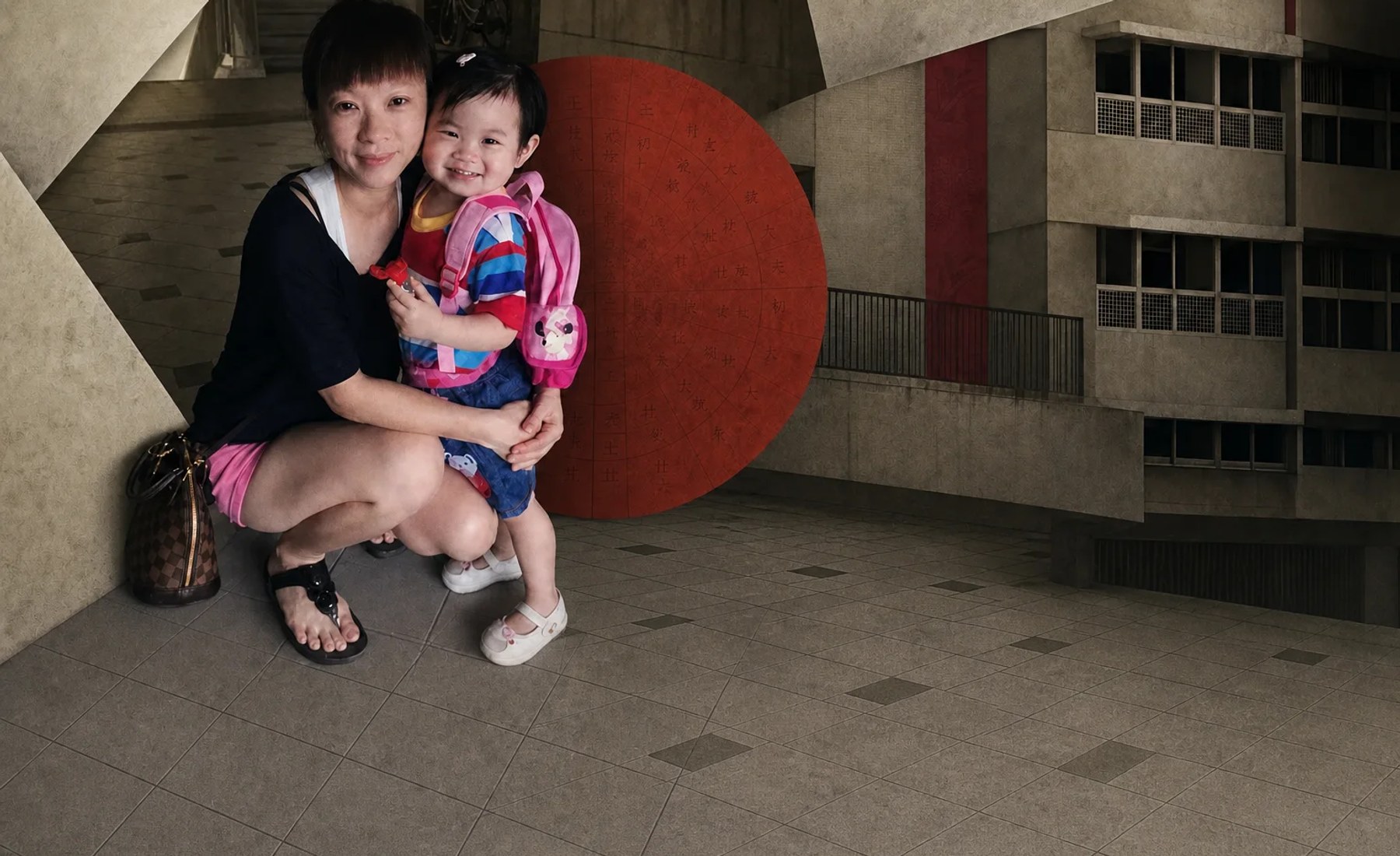


The Property Agent and the Housewife
Teo Ghim Heng, also known as Eric Teo, was by outward appearances an ordinary Singaporean man. Born around 1976, he was about 41 years old at the time of the murders. He worked as a property agent and in his prime earned a very comfortable income – by some accounts between S$10,000 and S$15,000 a month during the good years.
Friends and colleagues saw him as sociable and efficient, describing him as a good worker, a committed husband, and a doting father to his young daughter. Teo had been married once before, as had his later wife Pei Shan; this 2009 marriage was the second for both of them. Despite whatever past disappointments they may have had in earlier marriages, those who knew the new couple felt they were a loving pair who truly wanted a family of their own.
Choong Pei Shan was 39 in 2017. Described as a housewife at the time, Pei Shan was actually well-educated – a former teacher – but had left her job to focus on raising their child (and possibly due to complications with earlier pregnancies). She and Teo married on 7 December 2009.
A Light in the Family
Having a child did not come easy – Pei Shan suffered several miscarriages in the early years of their marriage. Finally, in 2013, joy came: Pei Shan gave birth to a healthy baby girl, whom they named Teo Zi Ning.
Zi Ning quickly became the light of the family. By all accounts, she was an outgoing, cheerful child adored by her relatives. Teo's elderly mother, Mdm Cheong Goik Keow, would later testify that her granddaughter was "very cute and outgoing" and "adored by everyone" in the family.
Little Zi Ning loved to sing and dance – during Sunday family dinners, she often performed for her doting grandparents, aunts, and uncles. Her mother Pei Shan was devoted to her, and the two were inseparable; relatives observed that Pei Shan and Zi Ning were extremely close.
In the early years, Teo seemed to be a caring husband and father. He often showed affection toward Pei Shan – messages between them revealed a loving tone, with Teo "constantly showering his wife with affection" even amid difficulties.
According to Teo's own family, he almost never shared any personal problems or worries with them. To his mother and siblings, he presented the image of a man happily managing his own household.
The Mark Mu Affair
But behind closed doors, the Teo household had its share of private turmoil. In 2014, a major rift occurred: Teo discovered Pei Shan in their bed with another man. Pei Shan had been having an extramarital affair with someone identified in court only as "Mark Mu". Teo was enraged and deeply hurt. For a moment, he even doubted if he was truly the father of little Zi Ning, who was just one year old then.
Despite this betrayal, Teo made a surprising choice – he forgave his wife's affair. He later said he did it for the sake of their daughter, who he ultimately accepted was indeed his child. Pei Shan ended the affair, and the couple moved on, but not without scars. Resentment lingered in Teo's heart. Though outwardly he reconciled with Pei Shan, the memory of her infidelity would resurface in future arguments, a bitter thorn never fully removed.
S$120,000 in the Red
By 2015, life threw another challenge at the family: financial collapse. The once-booming Singapore property market cooled, and Teo's earnings as an agent plummeted. The high-rolling days of five-figure monthly commissions were over. As his income dried up, Teo struggled to maintain the family's lifestyle. Bills piled up. He began missing payments – Zi Ning's kindergarten fees went unpaid for months. Teo also developed a gambling habit, which only worsened their finances.
To stay afloat, he resorted to borrowing money from friends, colleagues, banks, and licensed moneylenders – anyone who would extend credit. Debt snowballed. By January 2017, Teo was approximately S$120,000 in debt – a huge sum for a family of his means. He was essentially robbing Peter to pay Paul, taking new loans to pay old ones.
This precarious financial juggling was hidden from his extended family and perhaps mostly from Pei Shan as well, at least initially.
In late 2016, with property sales still sluggish, Teo changed jobs. He took a position as a sales coordinator at a renovation firm for a steady salary of around S$1,500 per month – a far cry from his past earnings, but at least a paycheck. Unfortunately, this did little to resolve their money problems. The family's expenses remained high, and creditors were closing in.
Desperate to avoid bankruptcy or worse, Teo quietly listed their Woodlands flat for sale in hopes of using the proceeds to clear the debt. He also considered selling their car. Every option was on the table – except, it seemed, openly asking family or professional counselors for help.
Pride and shame kept Teo from telling his relatives about the true extent of his troubles, and as we'll see, perhaps kept Pei Shan from sharing her marital woes with her own family too.
A Baby They Couldn't Afford
Amid this financial storm, another development arose: Pei Shan became pregnant again in late 2016. The couple was expecting a baby boy, due in May 2017. However, instead of pure joy, this news brought mixed feelings. How would they afford another child now?
At one point in November 2016, their situation was so bleak that they considered aborting the pregnancy. According to later court evidence, they even sought counseling about it, and ultimately decided not to go through with an abortion.
Perhaps they hoped that somehow their fortunes would improve, or they couldn't bear to terminate a precious life after having struggled to conceive in the past. Whatever the reason, they prepared to welcome a son, even as their finances continued to crumble. The impending birth added more stress: prenatal check-ups, future hospital bills, baby supplies – all looming expenses.
Money (or the lack thereof) became a constant source of friction between husband and wife. Teo reportedly asked Pei Shan to find a part-time job to supplement their income, but she refused.
Meanwhile, Pei Shan remained unaware of some aspects of their situation until it exploded into view.
Creditors at the Door
In the weeks leading up to the murders, the Teo household was a pressure cooker of stress and secrets. The first alarm bell rang loudly on January 13, 2017. On that day, some of Teo's creditors showed up at the family's flat demanding payment.
For Pei Shan, it was a rude awakening. If she hadn't known the full extent of their debt before, she certainly did now. She realized the family owed a massive sum – reportedly around $120k – and that they were essentially broke. Her trust in her husband to be a good provider was shattered. This incident on January 13 ignited frequent quarrels between the couple over money. What had been a simmering issue was now an open, constant argument.
One particular argument occurred on January 18, 2017, just two days before the murders. According to later court testimony, the couple fought bitterly over their finances that day. In the heat of this quarrel, Teo dredged up the painful memory of Pei Shan's 2014 affair.
In his mind, all his sacrifices – forgiving her infidelity, taking on all the financial burden – were being thrown back in his face by her nagging about money.
The emotional wounds from that betrayal were clearly still raw for him. By this point, their marriage was on the brink: trust was eroded by money troubles and past infidelity, and stress levels were sky-high.
January 20, 2017
All this tension set the stage for the fateful morning of January 20, 2017. It was a Friday. Four-year-old Zi Ning woke up to get ready for kindergarten as usual. She pulled on her little school uniform, probably expecting it to be like any other day. But Teo knew something that she didn't: he had not paid her school fees for a long time, and the principal had been sending him urgent reminders.
By now, the unpaid fees amounted to S$1,700. There was simply no money left to pay them. Teo was terrified that Zi Ning would be expelled or humiliated by being turned away at school if he brought her in that day.
In a panic (or a misguided attempt to postpone the inevitable), Teo decided not to send Zi Ning to school that morning. He told the puzzled child to change out of her uniform and stay home to watch TV instead.
When Pei Shan discovered that Zi Ning had been held back from school, she confronted Teo. A blazing row ensued in the master bedroom. They had fought about money many times in the past week, but this argument would be the last. Pei Shan was furious that Teo's failure to pay the fees was now disrupting their daughter's education.
'Look at Your Father, See How Useless He Is'
At some point, harsh words were exchanged that would later be replayed in court testimony.
According to Teo's account, Pei Shan snapped and insulted him cruelly during this fight. In her anger and frustration, she called him a "useless" husband and father. What's more, she dragged their daughter into it: Pei Shan allegedly told Zi Ning (in Mandarin) "Look at your father, see how useless he is!" – right in front of Teo.
It's hard to imagine a more humiliating, emasculating blow for a man already drowning in shame. To be belittled by his wife, in front of the child he adored, struck directly at Teo's pride. For a traditional Asian husband, being deemed incapable of providing for one's family can be a devastating assault on identity.
Those words were the breaking point. Years of bottled resentment – over the affair, over financial blame, over his own sense of failure – exploded in that moment. Teo later described experiencing a "red mist" clouding his mind in rage. He completely lost control of himself, or so he claimed.
Enraged beyond reason, Teo grabbed a towel from nearby. He looped the towel around Pei Shan's neck from behind. This was no impulsive shove or slap; it was a deliberate act. As forensic psychiatrist Dr. Derrick Yeo noted, Teo was "goal-oriented" enough in his anger that he left the room to fetch a towel as a strangling weapon, indicating a moment of perverse planning. Teo pulled the towel tight around his pregnant wife's throat.
Pei Shan must have panicked and fought back, but she was at a physical disadvantage: he was a 41-year-old man, stronger, and she was six months pregnant, carrying the weight of a baby.
The struggle was intense. Teo applied so much force that at some point he dropped the towel and began using his bare hands to throttle her. Pei Shan desperately gasped for air, scratching at his arms, trying to scream. Just feet away, Zi Ning was in the same room, playing and watching television – blissfully unaware at first of the horror unfolding behind her. But surely, as her mother's life was being violently taken, the child realized something was wrong.
Pei Shan's fight for life lasted several minutes. Teo would later admit that about five minutes into strangling her, the initial blind rage – that "red mist" – had passed. In other words, his mind cleared and he knew exactly what he was doing as he continued to choke the life out of his wife. Pei Shan eventually went limp. Her last breaths came as her husband's hands crushed her windpipe. The mother of his child, and the unborn son she carried, were gone. It was murder, fueled by anger and a warped sense of despair.
'Don't Be Scared, Papa Is Here'
Yet, the horror was only half complete. Little Zi Ning had witnessed at least part of the attack on her mother, or at minimum saw the aftermath. After killing Pei Shan, Teo turned to his daughter. In an instant, he made a nightmarish decision: if his wife was dead, he would kill their child and himself as well, to "reunite the family" in death.
He would later tell a psychiatrist that he didn't want his loved ones to suffer or be hounded by his creditors, and thought this was a way out for all. It was the ultimate distortion of a patriarchal sense of responsibility – "I got us into this mess, I'll take us all out of it."
Teo approached Zi Ning, who was surely frightened and confused. He tried to calm the child in her final moments. He sat down and gently pulled his daughter onto his lap, saying softly, "Don't be scared, Papa is here."
Then, he took the same blood-stained towel and looped it around the little girl's neck. In Mandarin, he gave her a heartbreaking instruction: "Go find your Mummy first, Papa will come soon." Essentially, he told his 4-year-old child that she should join her mother in death, and that he would join them shortly after.
As Teo tightened the towel, Zi Ning began to cry, softly at first, then louder. She was terrified, struggling against her father's garrote. Her cries soon turned to choked, unintelligible sounds as the towel cut off her air. Even as she suffered, Teo kept up his twisted reassurance.
When he noticed "bubbles" forming at her mouth – a sign she was near death – he removed the towel briefly, only to finish the job with his bare hands. As he strangled his daughter, he whispered in Mandarin, "Darling, go find Mummy already." Those were the last words Zi Ning ever heard.
In a matter of minutes, Teo Ghim Heng had annihilated his entire family. Pei Shan lay lifeless on the floor or bed, and Zi Ning's small body grew still in his arms. The unborn baby boy, who would never be named, perished with his mother – making this effectively three lives lost in one murderous outburst.
The crime was as tragic as it was horrifying. Singapore, a country known for its low violent crime rate, would soon learn that this respected real estate agent and family man had become a family killer – a rare familicide that sent shockwaves through the nation.
Eight Days with the Dead
After the red mist of rage cleared and the reality of his deeds set in, Teo was faced with two bodies and a ghastly scene in his flat. One might expect that immediate remorse or panic would drive him to call the police or someone for help. But what followed was eight days of disturbing behavior that showed a cold and calculating side to Teo's actions.
Instead of turning himself in, Teo decided to hide the murders and carry out the final part of his grim plan: taking his own life. Over the next week – from January 20 to January 28 – Teo lived in the flat with the corpses of his wife and child. He carefully placed Pei Shan and little Zi Ning together on the bed, arranging their bodies almost as if they were merely sleeping.
On that bed, he continued to sleep every night beside the remains of his loved ones. It's a macabre image: a husband and father, every night curling up next to the slowly decomposing bodies of the family he himself had killed.
Teo took calculated steps to delay discovery and decomposition. He kept the air-conditioner running continuously in the bedroom to keep it cool. The closed, chilled room would slow down the decay of the bodies and reduce the smell of death.
He also shut all the windows tightly to prevent any odors from escaping the flat. These actions were not those of someone in shock or stupor; they indicated clear, rational thinking to cover his tracks – something the court would later note as evidence of his full mental faculties after the crime.
During those days, Teo diligently crafted a cover story. He wrote four suicide notes, trying to frame the narrative that he, his wife, and their daughter had decided on a family suicide pact due to the unbearable stress of their financial situation. He forged Pei Shan's signature or voice in these notes to make it appear she willingly agreed to this plan.
Of course, this was a lie – Pei Shan had fought desperately for her life. But Teo hoped that if all three were found dead together with such notes, people might believe they all consented to die together, perhaps sparing him (in death) from being vilified as a murderer.
Teo also manipulated social media to avoid suspicion. Pei Shan was active on Facebook, often posting photos of Zi Ning. After killing her, Teo logged into Pei Shan's Facebook account and changed her profile's cover photo, just to give the illusion that she was still alive and using her account during that week.
This little digital deception was meant to throw off anyone who might notice her sudden silence – if her profile was updated, perhaps she's fine.
Meanwhile, concerned calls and texts were indeed coming in. As the Lunar New Year holiday approached, both Teo's and Pei Shan's families were wondering about their whereabouts – not to mention Zi Ning's school, which wanted to know why she was absent. Teo lied repeatedly to all who inquired. When Zi Ning's school called, he would claim his daughter was ill and couldn't attend.
When family members asked about Pei Shan, he variously said that she and the child were busy, or that they were out, or that they had taken ill. He made excuses to avoid scheduled family gatherings, including the weekly Sunday dinners and the upcoming New Year visits.
For instance, he told relatives that they wouldn't be joining the customary reunion dinner because Pei Shan had "stomach flu" or some ailment – even going so far as to say she was hospitalized briefly and then back home resting. Each lie was an attempt to buy time.
Inside the flat, Teo also busied himself on the internet. Far from sinking into paralyzing despair, he actively researched ways to kill himself. Web browsing history later showed he looked up various suicide methods – a sign that he was very much mentally alert and planning his next steps, not incapacitated by madness.
He made multiple attempts on his own life, though none succeeded. He slit his wrists, but apparently the cuts were not deep enough to be fatal. He drank insecticide, poisoning himself, but not enough to finish the job. He even swallowed hundreds of paracetamol (acetaminophen) tablets in an overdose attempt. Remarkably, even ingesting that many pills did not kill him (though it did cause liver damage that required later medical treatment).
It seems Teo's resolve to die was not as strong as he imagined, or perhaps survival instinct kept making him "chicken out" at the last moment. Dr. Yeo, the psychiatrist, would later comment that Teo "wanted to die on his own terms but many of the attempts he tried were either too painful, too difficult or not successful for him." In other words, Teo could not bring himself to endure the pain required for suicide by those means.
As the days passed, the bodies of Pei Shan and Zi Ning remained on the bed. Teo ate meals in the flat and slept regularly, indicating a disturbing level of calm in the presence of his gruesome handiwork. He continued to surf the web, even visiting pornography sites frequently – both before and after the murders.
This detail, while lurid, later served to debunk his defense's claim that he was severely depressed; a truly depressed person, experts argued, would not have the libido or motivation for such activities. It painted a picture of a man who, after the initial rage, was disturbingly unrepentant or emotionally numb, carrying on daily functions with two dead bodies in the next room.
'Your Sister Is Dead'
To outsiders, the Teo family's absence was increasingly alarming. Both sides of the family were expecting them for Lunar New Year celebrations. In Singapore, the Lunar New Year (Chinese New Year) is the most important holiday for Chinese families – a time when no matter what's happening, you reunite with parents and siblings to celebrate.
Pei Shan's family, the Choongs, grew especially worried when she missed the traditional Reunion Dinner on the eve of the New Year. They were told by Teo that she had stomach cramps and had been to the hospital, which raised red flags. By the next day (New Year's Day), when she still didn't show up or call, her brother Gordon and their parents were in a near panic.
January 28, 2017 – It was the first day of the Lunar New Year, a day when families dress in new clothes and pay visits to relatives, exchanging mandarin oranges and well-wishes. For the Choong family, however, celebration had turned to concern. Early that New Year morning, Gordon Choong tried calling his sister Pei Shan again.
This time, Teo answered and casually claimed that Pei Shan was "taking a shower" and couldn't come to the phone. Gordon asked Teo to please have her call back when she was done. Of course, no return call came.
When Gordon learned that his parents also hadn't heard from Pei Shan, alarm bells rang louder. Pei Shan was pregnant – what if something bad had happened to her health? In a family discussion, they realized the explanations they'd been given were contradictory and didn't make sense. Teo had told Gordon that Pei Shan kicked him out after a fight, yet on the phone that morning he implied he was with her at home (since he said she was showering).
Also, Teo had told the Choong family that Zi Ning was with his own sister, which Gordon knew was unlikely because Pei Shan never let her daughter out of her sight if she could help it. The lies were unraveling under even slight scrutiny.
By afternoon, Gordon couldn't ignore the gnawing feeling that something was terribly wrong. He decided to go personally to Pei Shan's flat to check on her, bringing along his other brother-in-law, Chris (husband of another Choong sister) for support.
They arrived at Block 619 Woodlands Drive 52 and found the unit quiet and dark. They rang the doorbell and banged on the door, shouting for Pei Shan and Zi Ning. No answer. They went outside to the common corridor windows of the unit and knocked on the windows, calling her name – still no response. Neighbors hadn't seen the family in days and reported nothing unusual; the Teos had kept to themselves that week.
That's when Gordon pried open one of the window louvers to peek inside. As soon as the gap opened, an overwhelming smell rushed out. Gordon recoiled, eyes watering. He later said it was a smell he "could not recognise" but it stung his nose.
He described it as a pungent odor that immediately made him suspect something was very amiss – something rotting, or the acrid scent of smoke. Indeed, what he smelled was a combination of decomposing flesh and burnt material. Though the aircon had slowed decomposition, after a week there was still a smell, and more so there was the lingering smoke from a fire Teo had set (we'll get to that shortly).
At this point, Gordon did the sensible thing and called the police. He told them he feared a gas leak or something dangerous inside, since there was a strong odor and no response from the occupants. Police and Singapore Civil Defence Force officers (which include firefighters and paramedics) were dispatched to the scene. They arrived in the early evening, just as many families were sitting down to their New Year dinners – completely unaware of the grim drama unfolding in this Woodlands block.
The first responders, mindful of the mention of a smell, had Gordon and Chris step back. They themselves noted a burning, acrid smell from the slightly open window.
Concerned it might be a gas leak or something combustible, they had everyone switch off their mobile phones as a precaution (to prevent sparks). Then they began calling out for anyone inside while knocking firmly. After some long moments, to everyone's surprise, the front door suddenly opened a crack.
Standing there was Teo Ghim Heng, alive. Gordon was stunned to see his brother-in-law inside the flat he was supposedly "chased out" of days ago. Teo was shirtless or wearing disheveled clothes, looking dazed. A chain still latched the gate, so there was a barrier between Teo and those outside. Gordon demanded to know where his sister was. Teo weakly lied, claiming Pei Shan had "gone out".
His voice and appearance must have been strange – he had, after all, not eaten properly in days and had tried to kill himself multiple times. The police weren't satisfied and ordered him to fully open the gate, warning they would cut the padlock if he didn't.
Under pressure, Teo finally unlatched the gate and stepped out. That's when Gordon angrily confronted him face-to-face: "Where is my sister? Tell me!" he shouted. Teo's response was chillingly direct – he came close to Gordon's face and said quietly, "Your sister is dead.". With that, he suddenly dashed off down the corridor, making a break for it.
Perhaps he thought of jumping off the building to finally accomplish his suicide. But Gordon and the officers were quicker. Gordon managed to grab him within a few steps, and then police officers tackled Teo to the ground and restrained him. Teo Ghim Heng was placed under arrest right then and there, on suspicion of murder.
Crime Scene in a Cold Room
With Teo secured, officers entered the flat. What they found inside was a scene of absolute horror. In the master bedroom, on a badly burnt mattress, lay the charred bodies of Pei Shan and little Zi Ning. The corpses were blackened from fire, which initially might have made it hard to identify them by sight. The air conditioning was still on full blast, and the room was unnaturally cool. Soot coated the walls and ceiling from smoke.
It appeared that at some point not long before the police arrived, Teo had poured an accelerant and set the mattress on fire, attempting to cremate the bodies and kill himself in the blaze. However, the fire had not engulfed the whole flat – likely it smoldered and then died out, producing smoke but not consuming everything.
Teo himself later claimed he lay down next to the burning bodies hoping to die in the fire, but "chickened out" because of the heat and jumped up. He ended up only superficially burned or singed, while the corpses bore the brunt of the flames. The result was that he partially destroyed evidence of the crime (by charring the bodies), but enough remained to tell the tale.
First responders also found the various suicide notes Teo had penned, as well as evidence of his internet searches and other preparations. They noted that the refrigerator was stocked with food containers, indicating he had been eating, and observed blood stains in the bathroom from his wrist-cutting attempt.
It was a gruesome and tragic crime scene, but there was no doubt what had happened: a mother and child murdered, and the prime suspect the very husband/father who lived with them.
The Prosecution's Case
In the aftermath of the discovery, the Singapore police made a statement acknowledging the horrific nature of the case. They emphasized that Teo had been given full due process and would face the law. The public was stunned as news broke that evening and into the next day (Jan 29). The story of a family annihilation in a typically safe neighborhood was almost incomprehensible.
Neighbors who knew the family expressed shock, saying the couple had appeared polite and normal, with no signs of such trouble. Pei Shan and Zi Ning's extended family was devastated – they had lost not one, but three loved ones (counting the unborn baby) in one fell swoop. Instead of celebrating the New Year, they were now planning funerals.
Notably, even Member of Parliament Vikram Nair (who represented the district) visited the wake to offer condolences, reflecting how the tragedy resonated community-wide. The high-profile undertaker Roland Tay, known for handling funeral arrangements in sensational cases, helped with Pei Shan and Zi Ning's funeral and later their cremation.
On January 31, 2017, a somber wake was held for mother and daughter. Photos from local media showed mourners in tears and a little white coffin alongside a larger one. What should have been a joyous season had turned into a period of mourning.
Meanwhile, after his arrest, Teo Ghim Heng was in police custody. Given his overdose of pills, he was first taken to a hospital under guard to treat the paracetamol poisoning and any other injuries. Once medically cleared, he would face the consequences of his actions in the justice system.
The Singapore Police quickly began building their case against Teo. It wasn't a whodunit mystery – Teo essentially confessed at the scene when he told Gordon "your sister is dead, it's my fault" (as he reportedly said at one point). Nonetheless, thorough investigations were carried out.
Forensic pathologist Dr. George Paul conducted autopsies on Pei Shan and Zi Ning. Even though the bodies were charred, the pathologist was able to conclude that both victims died by strangulation/smothering – consistent with what Teo eventually admitted. The unborn baby boy's death was attributed to his mother's death (fetal demise due to maternal demise).
The police also processed the scene, collecting the towel (if it survived the fire) and other evidence of intent. They recovered the suicide notes and confirmed they were written by Teo alone (handwriting analysis, etc.).
They also found the bank statements that painted the picture of his financial desperation. Investigators even discovered Teo had bought air fresheners and placed them in the flat to mask the odor of decay and burning. This detail came out later during his appeal – it showed how methodical he was in covering his tracks. Additionally, logs from Pei Shan's Facebook account showed the activity where Teo changed her cover photo around Jan 25, further evidence of his deceptive post-crime behavior.
Within two days of the bodies' discovery, Teo was deemed well enough to appear in court. On January 30, 2017, he was formally charged with murder. Initially, two counts of murder were filed: one for killing Pei Shan, and one for killing Zi Ning. These were charged under Section 300(a) of the Penal Code, which is murder with intent to kill – the most serious form of murder in Singapore. Conviction under Section 300(a) carries the mandatory death penalty.
Singapore is known for its tough laws, and in particular, murder (as defined in certain sections of law) has only one punishment: death by hanging. There is no option for life imprisonment if the charge is Section 300(a) and the accused is found guilty; judges have no discretion to impose any other sentence in such cases.
Interestingly, a third charge of murder (for the death of the unborn baby) was also technically possible. Indeed, prosecutors initially filed a third count related to the male fetus, since under law a viable unborn child (over 6 months gestation) can be considered a "person" for such charges.
However, that third charge was "stood down" (put aside) during the trial and later withdrawn after the main convictions. There was little point pursuing it – Teo could only be hanged once, and proving murder of an unborn (with questions of intent) would be an unnecessary formality once he was already facing execution for the two clear murders.
After being charged, Teo was remanded (kept in custody) as the police continued investigations. He was sent for a psychiatric evaluation at the Institute of Mental Health (IMH), which is standard in such severe cases to assess if the accused has any mental illnesses that could affect criminal responsibility. Teo spent about three weeks under psychiatric observation.
During this time, the case made headlines repeatedly. The local Chinese press labeled it the "兀兰双尸三命案" – literally the "Woodlands double-corpse triple-death case," highlighting the fact that three lives (including the fetus) were lost. Public sentiment was a mix of sorrow and outrage. Many asked: What could drive a father to kill his own child?
Others pointed to the stigma of debt in Asian culture – the shame can be so extreme that some consider suicide or even murder-suicide. There were also discussions about how to better support families in financial crisis or dealing with mental health issues, to prevent tragedies like this.
But as details emerged that Teo had calmly lived with the bodies and carefully tried to conceal the crime, sympathy for him waned. It appeared less like a temporary insanity and more like a coldly executed plan followed by self-preservation.
In a dramatic moment about two weeks after the arrest, on February 10, 2017, investigators took Teo back to the crime scene for a re-enactment of the murders. This is sometimes done to verify the suspect's account against the evidence. Dressed in a red polo shirt and blue checkered shorts – the same clothes he had on when arrested – Teo was cuffed at the wrists and ankles and escorted by officers into the flat he had once called home.
He looked downcast and said little, mumbling only to answer which key opened the door when asked. The media captured photos of him being led in shackles, a haunting image of a man returning to the scene of his unforgivable deeds. (One such photo shows Teo in a red shirt flanked by police, head bowed as he's guided along the corridor.) A handcuffed man in a red shirt being escorted by plainclothes police officers during the crime scene reenactment.
The Battle of the Psychiatrists
Over the next months and years, as the case proceeded through the courts, more chilling details would come to light – from Teo's own statements and from witness testimonies. The stage was set for an emotionally charged trial to determine this family murderer's fate.
It wasn't until mid-2019 – over two years after the murders – that Teo Ghim Heng's trial began in the High Court of Singapore. Such delays aren't uncommon in capital cases, as both prosecution and defense painstakingly prepare their evidence. When the trial opened, Teo was facing two counts of murder under 300(a), as mentioned. He chose to contest the charges, meaning he did not plead guilty; instead, his defense team would try to reduce his culpability, if not secure an outright acquittal.
The trial would reveal two starkly different narratives about Teo's mental state and intentions:
The Prosecution alleged Teo was a cold-blooded murderer who intentionally killed his wife and child in full awareness of his actions, driven by rage and a perverse desire to avoid his personal failures. They argued that his actions before, during, and after the killings showed clarity of mind, planning, and self-preservation – incompatible with any claim of diminished responsibility or temporary insanity.
They pointed out how he vividly remembered and could describe the murders in great detail, indicating presence of mind. The fact that Zi Ning did nothing to provoke him (being an innocent child) yet he killed her anyway underscored his cruel intent.
Teo's lawyers (led by Eugene Thuraisingam, a notable defense attorney) painted him as a mentally broken man, a loving father and husband who snapped under the weight of depression and grave provocation. They did not deny that he caused the deaths, but they aimed to convince the court that he should be found guilty of a lesser offense – culpable homicide not amounting to murder, instead of murder – due to diminished responsibility from a major depressive disorder, and/or that he was provoked into a sudden loss of self-control by his wife's harsh words.
These are partial defenses under Singapore law: if they succeeded on the diminished responsibility plea, the charge would be reduced and the mandatory death penalty could be avoided. In essence, they argued Teo was not in his right mind and could not fully control or understand his actions at the time.
During the trial, which lasted several weeks, the court heard from numerous witnesses: family members, investigators, and crucially, expert psychiatrists from both sides.
One of the most gripping testimonies came from Mr. Gordon Choong, Pei Shan's brother, who recounted the discovery of the crime. Speaking in court in July 2019, Gordon relived the trauma of that New Year's Day.
Teo's elderly mother, Mdm Cheong Goik Keow, was actually called as a prosecution witness, somewhat unusually. One might expect a mother to testify for the defense in mitigation, but here the prosecution used her testimony to demonstrate that Teo had a normal loving relationship with his family.
Through a Teochew interpreter (she wasn't fluent in English), Mdm Cheong confirmed to the court that Teo had always appeared to love his wife and daughter deeply. She shared tender details, like how the little girl was beloved by everyone and how Teo seemed like a caring husband.
This might seem to help Teo's character, but it actually helped the prosecution undermine any narrative that Teo was pushed to violence by some hatred or estrangement – emphasizing that the murders were not an act of someone who had a hostile relationship, but someone who snapped despite a loving one, which the prosecution argued pointed to deliberation rather than uncontrollable insanity.
The heart of the trial became the battle of psychiatric experts. The defense's psychiatrist diagnosed Teo with Major Depressive Disorder, suggesting that his mental capacity was substantially impaired at the time of the killings. They argued he had been depressed for months due to his financial woes, shame, and marital issues, and that this illness, combined with the immediate grave provocation of his wife's insults, led to a sudden, uncontrollable act.
On the stand, Teo's lawyers tried to highlight symptoms: Did he have insomnia? Loss of appetite? Loss of interest in life? Suicidal ideation? They pointed to his suicide attempts after the fact as indicative of his mental state.
However, the prosecution's expert, Dr. Derrick Yeo (a senior consultant forensic psychiatrist at IMH), delivered testimony that systematically dismantled the defense's claims. Dr. Yeo had interviewed Teo at length and assessed all the evidence. He testified that Teo's account to him showed a man who was not of unsound mind at the time, but rather capable of planning. He noted the critical fact that Teo was goal-directed enough to retrieve a towel as a weapon – an action inconsistent with an out-of-control frenzy.
Yeo explained that Teo's own explanation for the murders was quite rational in a twisted way: Teo said he "gave up" on life due to the debts and decided as the head of the household to "end all their lives together" so that no one would come after them for money. This showed some form of logical (if extreme) reasoning and a degree of planning – not a mind in total chaos. In Dr. Yeo's expert opinion, Teo had no delusions or hallucinations, and did not suffer from an abnormality of mind that would qualify as diminished responsibility.
Furthermore, Dr. Yeo highlighted Teo's behavior after the killings as very telling: the lies to relatives, the manipulation of Facebook, the cleaning up and attempts to preserve the scene. All this showed shrewd thinking and self-control, inconsistent with someone in a major depressive fog.
Teo also remembered clearly what happened during the killing, including the exact insulting words Pei Shan allegedly said and his own actions, which a person in a truly dissociated state might not.
'Being Upset Is Not the Same as Being Depressed'
The judge, Justice Kannan Ramesh, engaged closely with the psychiatric evidence. In November 2020, after hearing all witnesses, Justice Ramesh delivered his judgment. He rejected all three defenses Teo's team put forward: diminished responsibility, grave and sudden provocation, and a constitutional challenge (the last was an argument questioning the constitutionality of the mandatory death penalty or aspects of the trial, which didn't gain traction).
On the diminished responsibility claim (the crux of the mental disorder argument), the judge was unpersuaded that Teo had been suffering from MDD to the extent required. He methodically cited evidence that countered each supposed symptom of depression:
The judge noted, "I'm not satisfied that he suffered depressed mood most of the day, almost every day," acknowledging Teo was upset about his situation, but "being upset is not the same as being depressed." He pointed out that messages exchanged between Teo and Pei Shan in the period before the murders did not show a depressed man, but rather a "loving husband" affectionately communicating with his wife. Teo even indicated optimism in some messages, saying he would "fight to the end" and not give up on their problems, suggesting he was not despairing to the point of clinical depression.
After the killings, Teo spent time surfing the web, watching videos, and viewing pornography – behavior inconsistent with incapacitating depression. He slept regularly, went out for meals (leaving the house to buy food), and did not show signs of extreme lethargy or inability to function. The judge remarked that Teo showed "no despondency" over the deaths; rather, his actions were pragmatic.
There was no evidence Teo had significant weight loss or appetite loss prior to the offence. In fact, if anything, his mother testified he seemed fine, and he was still carrying on normal activities.
One claimed symptom was loss of interest in sex (common in major depression). Teo asserted he had no sexual interest in his wife since 2015. But the judge called this out as false, noting "he clearly had sex with his wife as she conceived around July 2016." This inconsistency damaged Teo's credibility.
Teo claimed he had insomnia from depression, but his strong performance at work contradicted that. Even in his new job, there were no records of him underperforming or being unable to function due to lack of sleep.
Ultimately, Justice Ramesh concluded that Teo did not meet the criteria for major depressive disorder at the time of the killings. Teo may have been stressed and unhappy, but he was not "insane" or incapacitated by mental illness.
The judge memorably said: "I accept he was upset with his financial circumstances and the acrimony with his wife. But being upset is not the same as being depressed." He added that Teo's elaborate lying after the fact was "demonstrative of shrewd cognitive ability", not a compromised mind.
On the defense of grave and sudden provocation, the judge was similarly unswayed. Under Singapore law, provocation (if grave enough and sudden enough) can reduce a murder charge to culpable homicide. But Justice Ramesh noted a few key points:
While he was "prepared to accept that what Pei Shan said... made him angry" and that "a person in his shoes would arguably have felt incensed," he emphasized that not every insult or anger amounts to legal provocation. The standard is high – it must cause a total loss of self-control in an ordinary person.
Crucially, Teo himself admitted that his so-called blind rage (the "red mist") cleared after a few minutes, "within five minutes." At that point, Pei Shan was still alive, yet he decided to continue strangling her until she was dead. This showed conscious intent. The judge pointed out that Teo had alternative choices in that moment – he could have stopped when his mind cleared and his wife was still breathing. Instead, he chose to finish the act. That is not an uncontrollable loss of self-control; it is a deliberate killing.
Moreover, after killing his wife, Teo made the separate decision to kill his daughter who had not provoked him at all. An innocent child's murder cannot be excused by any provocation the father felt from the mother's words. The law of provocation wouldn't stretch that far.
Thus, on November 12, 2020, Justice Ramesh pronounced Teo Ghim Heng guilty on both murder counts. It was a "tragic case of lives lost and a family torn asunder," the judge remarked, but the law was clear.
The only sentence for such a conviction was death. The judge duly passed the death penalty on Teo, stating that the "maximum penalty for murder is death" and in this case it was merited.
He noted the senseless cruelty, particularly towards the child, and the calculated nature of the crime. The third charge for the unborn child's death was formally withdrawn since it was academic at that point.
Teo reportedly showed little emotion as the verdict and sentence were delivered (media accounts noted he appeared calm, even "stone-faced" upon hearing he would hang).
Even after the death sentence, the legal process had a few more steps. In Singapore, all death penalty cases are automatically eligible for appeal, and if the appeal fails, a final petition for clemency can be made to the President.
Teo's defense team did indeed file an appeal to the Court of Appeal, Singapore's highest court. The appeal (heard in 2021, with judgment delivered in February 2022) essentially re-argued that the trial judge was wrong to reject the depression defense. They hoped the appellate judges might find some misinterpretation of evidence or give more weight to certain factors.
However, the Court of Appeal dismissed Teo's appeal on Feb 23, 2022, upholding the conviction and death sentence. The highest judges in the land were unanimous: this was murder, plain and simple, with no legal excuse.
With his appeal lost, Teo's last hope was a Presidential clemency. In Singapore, the President (on Cabinet's advice) can commute a death sentence, though this is rare and usually only for specific humanitarian reasons or if something went wrong in the trial. Teo petitioned the President for clemency, as is the right of every death row inmate.
By now, Singapore's President was Madam Halimah Yacob (the first female President of Singapore). After consideration, clemency was denied. The police, in a news release on April 16, 2025, stated that "his petitions to the President for clemency were unsuccessful."
Dawn at Changi Prison
Thus, all legal avenues were exhausted. The case had wound its way from crime to punishment over eight long years.
On April 16, 2025, at dawn, Teo Ghim Heng was executed by hanging at Changi Prison. He was 49 years old. The Singapore Prison Service confirmed that the sentence was carried out per protocol. Teo went to the gallows as one of the few people in recent years in Singapore to be executed for a domestic murder (most executions in the 2010s–2020s were for drug trafficking, making this case stand out even more).
The execution news brought a somber finality to the case.
The Woodlands Double Murder remains one of the most heinous domestic crimes in Singapore's recent memory. It serves as a grim reminder that even in a peaceful, modern city, there can be intense pressure-cooker situations behind closed doors. Financial ruin, wounded masculinity, marital betrayal – these were the demons that haunted Teo Ghim Heng, culminating in acts of irreversible evil.
Primary reporting and references
- Woodlands double murders
WikipediaMay 01, 2025
- Woodlands deaths: Suspect brought back to flat for reenactment
TODAYFeb 10, 2017
- 兀兰双尸三命案‧ 法官:男子执意夺命杀妻女罪成死刑
Sin Chew DailyNov 14, 2020
Related episodes

The Fake Honor Killing
A young woman's death reveals a conspiracy orchestrated by the people closest to her.

The Missing Student
A student's disappearance after an exam exposes a devastating secret within her family.
Murder on the Yacht
A woman is killed aboard a yacht in Tonga, and her accused husband makes a brazen bid for freedom.