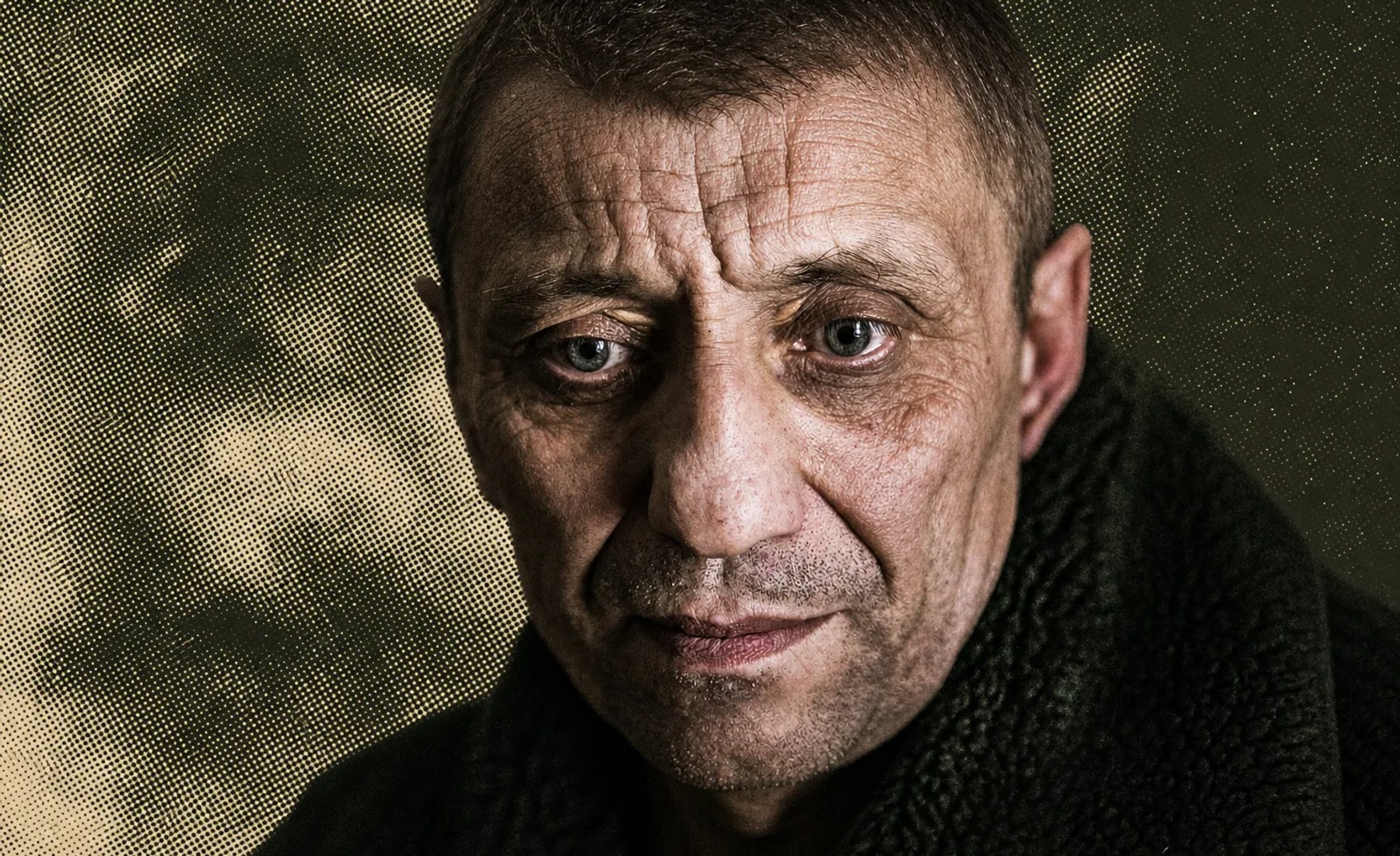


A Lonely Footpath Near Karlivka
Lyubov Syzonenko was returning home from a train station one autumn evening in 1998, not far from the small town of Karlivka in Poltava Oblast. She was 50 years old, a local woman on her usual route along a lonely footpath. Somewhere in the darkness, a figure was watching.
As Syzonenko walked, the stranger quietly followed. When she passed under a stretch with no lights, he struck suddenly. He had picked up a length of metal pipe from the roadside – and now he swung it with full force, cracking it against the back of her skull.
Syzonenko crumpled to the ground. Her attacker snatched her handbag and ran off into the night. Inside the stolen purse he later found only a little cash, some cheap cosmetics, and costume jewelry – hardly the haul he'd hoped for.
She had not regained consciousness by the time help arrived, and she died of her injuries soon after.
They Never Even Brought a Dog
In the immediate aftermath, the murder of Lyubov Syzonenko seemed like a tragic but isolated robbery-gone-wrong. The local police investigated, but no culprit was identified. According to later court testimony, the killer himself lay low for a few days, nervously expecting to be caught.
But nothing happened. The authorities did not even bring in a tracking dog that night – a basic step that might have followed the assailant's scent from the scene, since a light snow had not begun falling until early the next morning.
Years later, the murderer would recall his surprise: "I was sure they'd catch me after that first killing… All they had to do was bring a police dog – it would've picked up my trail. But it never even occurred to them," he said with a smirk.
Buoyed by the police's failure, he realized he had gotten away with it. And so, emboldened, he prepared to kill again.
The Airstrip
Just a few months later, in February 1999, another disturbing incident occurred – this time involving someone the killer actually knew. In the town of Karlivka, a young woman who happened to be the sister of his former school classmate crossed paths with him. The two spent an evening drinking together.
At some point, an argument flared. The man snapped: he strangled the woman and, when she lost consciousness, beat her over the head with a metal rod. He then dragged her limp body to a deserted field – an old airstrip outside town – and set it on fire.
The charred remains were later found, but at the time no one linked this heinous crime to the unsolved death of Lyubov Syzonenko. (It would take more than two decades for authorities to finally tie the 1999 killing to the same perpetrator, as we will later see.) In early 1999, all the police knew was that yet another murderer was on the loose.
The man responsible would not remain idle. His name was Ruslan Khudoliy. He was just twenty years old.
600 Miles Away
By late 1999, he had teamed up with an old army friend, Vasyl Buk, to embark on a far-ranging crime spree. Their partnership began far from Poltava, in November 1999, in the western Ukrainian town of Mukacheve – over 600 miles from Karlivka.
There, on a chilly evening, two young men walked into a small shop intending to rob it. One was Ruslan Khudoliy (unbeknownst to police at the time, he was the same man who had killed in Poltava), and the other was Buk. Neither man carried a real firearm initially; Khudoliy had only a knife for intimidation, while Buk was armed with a converted gas pistol capable of firing live rounds.
They thought it would be a quick, low-risk holdup. But things went wrong. A nearby police officer, hearing the commotion, rushed to intervene before they could grab any cash.
A scuffle ensued. Suddenly Buk raised his weapon and shot the officer in the abdomen. The policeman fell, badly wounded – but he managed to draw his service pistol and return fire as the robbers fled.
He emptied an entire 16-round magazine at the two fleeing figures, but miraculously every shot missed. Khudoliy and Buk disappeared into the night, escaping Mukacheve by the skin of their teeth. The officer survived his gunshot wound, and in the chaos of that night's chase, the suspects vanished without being identified.
This incident – a shootout with police in a quiet provincial town – was alarming enough on its own. But at the time, it was not connected to any larger pattern. How could it have been?
The notion that one of the Mukacheve robbers was also a burgeoning serial killer from Poltava was beyond anyone's imagination.
For Ruslan Khudoliy, however, the Mukacheve episode only fueled his wrath. He later admitted that after narrowly escaping the police that night, he grew even more contemptuous of them. The experience reinforced his twisted vendetta against law enforcement.
In his eyes, the police were inept – "pitiful, clumsy, incapable of stopping us," he scoffed. His resentment and arrogance deepened, driving him to up the stakes.
Whatever Was at Hand
Now back in his home region of Poltava, Khudoliy was determined to arm himself properly for future raids.
In late 2000, he acquired a 12-gauge double-barreled shotgun (an old IZh hunting rifle, by one account) and sawed off its barrels to make a compact, lethal weapon.
Armed and emboldened, Khudoliy struck again. On a night in September 2000, he crept into the yard of a farmhouse in the village of Fedorivka, not far from Karlivka. Under cover of darkness, he began snatching the family's livestock – stuffing several turkeys into a sack.
But as he prowled the coop, the 39-year-old homeowner heard the commotion and stepped outside to investigate. The intruder did not hesitate. He leveled his newly sawn-off shotgun and shot the man dead on his own doorstep.
Khudoliy then slipped away into the fields, taking with him some poultry and whatever small valuables he could find. In the span of barely two years, he had now killed at least three people (that we know of) across three different locales, with entirely different weapons. The randomness of his methods – a pipe bludgeon in one case, strangulation in another, a firearm in another – meant investigators failed to see any connection between these incidents.
The Fedorivka shooting was treated as a standalone rural robbery homicide; police noted the theft of livestock and assumed a local bandit or poacher was to blame. No one dreamed it was the same Karlivka man who had murdered the woman at the train station in 1998.
The Dairy Factory
By 2001, Khudoliy had drawn his younger brother Oleksandr (five years his junior) into his growing web of crime. Together with Vasyl Buk, the group set their sights on more lucrative targets. They began hunting for firearms – possibly to expand their arsenal for future robberies.
In mid-2001, an opportunity arose. Karlivka's local dairy factory employed armed security guards; Khudoliy knew this, as it was his hometown. Under cover of night, he and an accomplice ambushed two guards on duty.
In a sudden attack, the gang murdered both security men and seized their rifles. The killings were ruthlessly efficient. By dawn, two more bodies lay in the morgue, and Khudoliy had added two AK-47 assault rifles to his cache of stolen weapons.
The slaying of two uniformed guards on patrol jolted the community. Local police, suspecting that professional criminals or arms traffickers might be involved, redoubled their efforts to find leads. Yet, as with the earlier cases, no fingerprints, eyewitnesses, or obvious suspects emerged.
The killers had struck like ghosts and vanished.
Over the next year, Khudoliy and his band roamed further afield. They crisscrossed regions – from their base in Poltava Oblast to the Crimean Peninsula in the south and back to Zakarpattia in the west – committing robberies wherever a promising opportunity presented itself. Their exploits targeted small shops, remote farmsteads, and the homes of people they believed to be wealthy.
Cash, jewelry, firearms, even livestock and appliances – nothing was off-limits. The gang's modus operandi was brutally simple: strike at night, eliminate all potential witnesses, and leave no trace. If a homeowner resisted even for a moment, the result was lethal.
And if an unlucky stranger stumbled upon them during a burglary, that person, too, would be silenced. In one incident, Khudoliy would later admit, he killed a man essentially for "a bag of candies or 30 hryvnias" – the meager loot at stake.
A Hero of Socialist Labor
In October 2002, Khudoliy set his sights on a particularly notable victim: Andriy Fisun, a respected agronomist and community leader. Fisun was an elderly former collective farm manager who had been honored with the title "Hero of Socialist Labor" in Soviet times. Perhaps Khudoliy thought the old man's status meant he had money or valuables in his home.
Late one night, Khudoliy and Buk broke into Fisun's modest house on the outskirts of Poltava district. Inside, they surprised the 77-year-old Fisun and his wife, who was bedridden due to illness. The intruders demanded to know where any cash or weapons were kept.
Fisun, frail but proud, either could not or would not satisfy them. Khudoliy decided to leave no witnesses. He murdered Andriy Fisun and then killed Fisun's defenseless wife in her bed.
Ransacking the home, he found an old double-barreled hunting shotgun among Fisun's possessions. He took it, later cutting it down to use as yet another sawed-off murder weapon. The killing of a decorated local hero sent shockwaves through the community.
Here was an elderly couple, known and loved, slaughtered for a few valuables and a firearm. The press in Poltava dubbed the unknown perpetrator the "Poltava butcher" and speculated about roving gangs or ex-convicts who might be to blame. The authorities, now alarmed that a serial killer or gang might indeed be operating, quietly formed a special inter-district task force to investigate the string of violent robberies.
Still, no clear suspect emerged. Khudoliy's crimes had spanned such different locales and victims that police struggled to connect the dots. What's more, the killer's discipline in leaving no forensic traces stymied traditional detective work.
Each crime scene was frustratingly devoid of fingerprints or DNA. And of course, there were almost never any witnesses left alive.
My Hand Wouldn't Rise
Then came 2003, the year everything reached a crescendo. By now, Ruslan Khudoliy was on a personal mission to taunt and terrorize the authorities. He seemed to take perverse pride in outfoxing the police.
Indeed, he began timing some of his most horrific crimes to coincide with dates significant to law enforcement – delivering what he saw as "gifts" or insults on their professional holidays. In Khudoliy's warped mind, this was a one-sided contest between him and the militia (as Ukraine's police were then still called). And he intended to show them up at every turn.
Early in 2003, the gang struck in a village called Abramivka in Poltava's Mashivka district. The target was the home of the Khomenko family – ordinary rural folk, but rumor had it they kept savings hidden at home. Khudoliy and Vasyl Buk broke in during the night.
The noise woke the husband and wife inside. As the man came out of the bedroom to confront the intruders, Buk shot him dead without hesitation. Khudoliy then turned his gun on the wife, firing two shots into her head at close range.
Incredibly, those bullets missed the woman's vital organs – they passed through her temples but did not kill her outright. She collapsed, gravely wounded but still alive. At that moment, a small figure emerged in the hallway: it was the couple's four-year-old son, who had crept out from his hiding place under a chair.
The boy stared up at the armed intruders, eyes wide with terror. Khudoliy raised his shotgun to eliminate the last witness – then hesitated. Something stopped him.
"My hand wouldn't rise," he later explained. Looking at the trembling preschooler, he suddenly thought of his own little daughter at home, who was about the same age. In a rare flicker of mercy, the killer spared the child.
He and Buk fled, leaving the boy crying under the chair and his mother bleeding on the floor. By sheer fortune, that mother survived her grievous head wound – one of the very few people to survive a direct encounter with Ruslan Khudoliy. But she had seen almost nothing of the attackers; neither she nor her son could identify the perpetrators in any useful way.
Thus, even this botched robbery yielded no solid leads for police. Still, it marked a notable moment: it was the first and only time Khudoliy ever left living witnesses to one of his crimes. He would not make that "mistake" again.
A short time later, the duo tried another home invasion that likewise went awry – and this time resulted in two more senseless deaths. In mid-2003, Khudoliy and Buk targeted the house of a local businessman named Marukhnich in Karlivka. They believed he had a stash of cash.
One night, the pair crept into the yard, but found the house locked up tight with metal bars on the windows. Peering through a window, Khudoliy spotted a woman inside on the telephone – it was the businessman's wife, speaking with someone. Without warning, Khudoliy fired his sawed-off shotgun through the glass, killing the woman instantly.
Moments later, in a cruel stroke of fate, a neighbor arrived outside. The neighbor had been telephoned by Mr. Marukhnich (who was away on a trip) and asked to check on the house after the call abruptly dropped. She walked straight into the crime in progress.
Before she could react, Buk shot the neighbor dead with a pistol. Now two innocent women lay slain. And yet Khudoliy and Buk had nothing to show for it – they could not get past the barred windows, and the dead woman's husband had remotely alerted others.
Panicking, the intruders fled empty-handed. Later, with chilling nonchalance, Khudoliy would refer to those two murders as "accidental… people got shot, and nothing was taken". To him, it was just an unlucky outcome – not for the victims, but for his loot haul.
These reckless deeds in 2003 made it undeniable that a monster was stalking Poltava province. Ordinary families were being slaughtered in their own homes for trivial gain. The patterns were hard to discern, but investigators knew they had a serial murderer (or gang) on their hands.
Fear spread in every village. By late 2003, many rural residents were bolting their doors at dusk and keeping weapons by their bedside. The press began referring to the unknown perpetrator as the "Karlivka maniac." Police officials, under intense pressure, poured resources into the hunt.
They assembled special operative teams, set up stakeouts, and scoured criminal records for any known felons with a similar modus operandi. Frustratingly, none of it led to a breakthrough. Part of the problem was that Khudoliy's methods were so inconsistent that the police kept chasing false leads.
Some victims had been shot, others stabbed or bludgeoned; some robberies targeted money, others guns, others simply food. The diversity of crimes threw investigators off the trail. They arrested and interrogated various suspects – local troublemakers, known thieves, anyone with a firearms permit in the area – but turned up nothing solid.
The ongoing failure to catch the killer created enormous stress within the Poltava regional police. Sadly, that pressure led to miscarriages of justice: at least four innocent men were coerced into false confessions during this period, as the authorities grasped for solutions. In one case, two villagers from Popivka (Khudoliy's own childhood village) were bullied into confessing to a 1990s Karlivka murder they didn't commit.
Astonishingly, two of these falsely accused men were actually convicted and sent to prison – each serving five to six years – for crimes that were later proven to be Khudoliy's handiwork. Such were the desperate lengths to which the police had gone, trying to appease public outrage and close the cases by any means.
A Gift on Militia Day
Amidst this climate of fear and confusion, Ruslan Khudoliy was preparing his most brazen atrocity yet. He picked a date that would make a twisted statement: December 20, 2003, which in Ukraine was celebrated as the Day of the Militia (the professional holiday honoring police officers). On that night, in a hamlet near Karlivka, Khudoliy and his 21-year-old brother Oleksandr quietly approached the home of the Chynakhov family.
It was late; inside, the five family members were likely asleep or winding down for the night. The Chynakhovs included the father (Serhiy, 51), the mother (Halyna, 47), their teenage son, and two older female relatives who lived with them (one of whom was a schoolteacher). Without warning, Khudoliy smashed in a window or door and burst into the house armed with the sawed-off shotgun.
Oleksandr followed on his heels, carrying a heavy hammer. In the ensuing minutes, the brothers methodically exterminated the family. Ruslan Khudoliy opened fire, blasting his victims one by one with 12-gauge shotgun blasts.
Any who were still moving, Oleksandr finished off with hammer blows at close range. The brutality was staggering. When they were done, all five members of the Chynakhov family lay dead or dying in pools of blood.
Even the 11-year-old son – a child – had been fatally clubbed. There was no chance for any of them to escape or raise an alarm. The two assailants disappeared into the darkness, leaving behind a tableau of carnage meant to send a message.
Indeed, Khudoliy later admitted he targeted that family specifically on Militia Day as a way to mock law enforcement – a macabre "gift" to underscore their inability to catch him.
This mass murder finally galvanized the authorities at the highest level. The massacre of five people in one attack was among the worst crimes in Ukraine's post-Soviet history. Within days, a special commission from Kyiv had arrived in Poltava to oversee the manhunt.
Extra detectives were assigned, and the profile of the killer (or killers) was circulated widely. The police now publicly acknowledged that a serial killer gang was at work – dubbed the "Karlivka Gang" or "Karlivka Maniac" in media reports. Despite the heightened efforts, Khudoliy remained uncaptured as winter turned to spring.
But his frenetic run was nearing its end – thanks not to local sleuthing, but to a small technological mistake he'd made far to the south.
A Phone Lights Up in Poltava
Unbeknownst to Poltava investigators, one of Khudoliy's crimes had occurred about 400 miles away, in the city of Simferopol, Crimea. Sometime in 2003, Khudoliy had invaded the home of the Digtarенко family in Simferopol, murdering the inhabitants and looting valuables – among which was a mobile phone. This phone, a relatively expensive model (a Sony J70), lay dormant for many months.
But in the spring of 2004, it unexpectedly lit up on cellular networks. Crimean police, who had logged the phone's unique electronic ID after the unsolved Digtarенко murders, were alerted that the device was active again. And crucially, it was pinging from Poltava.
Investigators traced the signal to a specific subscriber number and address in Karlivka. After cross-referencing local records, they identified the resident: a 26-year-old former Internal Troops serviceman named Ruslan Vitaliyovych Khudoliy.
The name Ruslan Khudoliy immediately rang alarm bells. Detectives realized this was the same Karlivka man who had been on their long list of "persons of interest," though he had not been a prime suspect. Khudoliy had a clean (if modest) background – he was a veteran who had tried to become a police officer himself a few years earlier, then drifted into odd jobs.
Married with a young daughter, he lived quietly with his family on the outskirts of Karlivka. Now, however, there was hard evidence tying him to a murder in Crimea. The dragnet closed in.
Under the Bed
In June 2004, a Kyiv-based team from the CID (Criminal Investigation Department) descended on Karlivka to coordinate Khudoliy's arrest. Knowing his violent history, they planned a ruse to catch him off-guard. On the appointed day, traffic police staged a minor roadside incident right outside Khudoliy's house – a faked fender-bender intended to lure him out.
When Khudoliy came to his gate to observe the commotion, plainclothes officers approached and politely asked if he could serve as an impartial witness to the "accident." Khudoliy stepped outside, momentarily distracted. At that very same time, a second team of operatives quietly slipped into his house to conduct a swift search. What they found beneath the bed in the back room left no doubt of his guilt.
Hidden under the bed was a duffel bag containing a sawn-off shotgun and other firearms, ammunition, jewelry and personal valuables linked to various robbery victims, and even clothing stained with human blood. It was essentially a murderer's toolkit and trophy stash, all in one place.
Khudoliy was immediately taken into custody. He did not resist. In fact, witnesses recall that he seemed eerily calm – as if unsurprised that the day of reckoning had finally come.
His younger brother, Oleksandr, was also arrested the same day in a coordinated operation elsewhere in Poltava region. Investigators had gathered enough evidence (and testimony from informants) to tie Oleksandr to at least the Chynakhov family murders, so he too was swept up.
Candy Bars and Confessions
Back at the station, when confronted with the trove of evidence from under his bed, Ruslan Khudoliy at first stayed silent.
But the game was up and he knew it. Within hours, as interrogators began to outline the case, Khudoliy started to talk – and once he started, he did not stop.
Over the following days and weeks, Ruslan Khudoliy gave a series of voluntary confessions that left even veteran police officers stunned. As one report described, he spoke in a "somewhat ironic, cynical manner" – freely admitting to one crime after another, correcting the police on details as if he were discussing someone else's deeds. He had a peculiar request, too: he had a sweet tooth.
Investigators, realizing he opened up more when comfortable, indulged him by bringing candy bars and tea into the interview room. In exchange for these small treats, Khudoliy recounted six years of bloodshed in chilling detail. One detective later said they learned Khudoliy could kill a person for something as petty as "a bag of candies or 30 hryvnias" – and indeed, he had.
It was hard to fathom such wanton brutality over trifles. Khudoliy also volunteered a shocking admission: some of the murders pinned on others were actually his doing. He effectively cleared several unsolved cases, including the ones for which innocent men had been imprisoned.
At one point, Khudoliy even confessed to a murder the police hadn't definitively linked to him – the killing of a Poltava taxi driver named Serhiy Hreshnov, who had been found beaten and burned in 2002. (He seemed to revel in taking credit, but investigators remained unsure about that particular crime, as evidence was scant and his story had contradictions.)
Meanwhile, Oleksandr Khudoliy denied involvement in any killings except to admit he was present during some robberies. He claimed that any earlier confession he'd made was under duress.
His older brother Ruslan tried to shield him as well, insisting to authorities that Oleksandr "wasn't there" at certain scenes, even when forensic proof suggested otherwise. But those denials would carry little weight in the face of overwhelming evidence.
If You're So Smart, Let's See Who Wins
By July 2005, the pre-trial investigation was complete, encompassing a staggering 92 volumes of case files. The trial of Ruslan and Oleksandr Khudoliy opened in the Poltava Regional Court of Appeals (which by law acted as the trial court for this exceptionally grave case). The courtroom was packed with families of victims, journalists, and even the Khudoliy brothers' own parents.
Over the next several months, the court heard testimony from dozens of witnesses and experts. They examined each of the 33 distinct crime episodes that prosecutors charged to the Khudoliy gang – including 29 murders. The evidence was exhaustive: ballistic analyses matching bullets and guns, bloodstained clothing matched to victims' DNA, stolen goods traced back to specific robberies, and of course Ruslan Khudoliy's detailed confessions for most counts.
For the brutal murder of the Chynakhov family, forensic experts showed how the hammer recovered from Oleksandr's belongings fit the trauma inflicted on the victims' skulls. The surviving wife from Abramivka, still carrying bullet fragments in her head, testified to her ordeal – though she had not seen the attackers' faces, her account of two assailants aligned with the prosecution's case. In an unusual twist, Ruslan Khudoliy took the stand in his own defense only to confirm much of the prosecution's narrative.
He nonchalantly described several murders in first-person, at times correcting the record or adding his own commentary. When asked why he had killed so indiscriminately, Khudoliy finally articulated his perverse motive: it was revenge. He felt wronged that the police had once refused to hire him, and he set out to demonstrate their incompetence.
"He decided to work against the police after they wouldn't take him," one Ukrainian article noted, explaining that all of Khudoliy's gruesome deeds were, in his mind, a vendetta against law enforcement. Khudoliy described how he had been a model soldier in the Internal Troops and had expected to join the Militsiya afterward, only to be told to wait due to a lack of vacancies. This rejection enraged his sense of superiority.
From that moment, he said, he wanted to show up the authorities. "If you're so smart, let's see who wins…" he thought, casting himself in a deadly cat-and-mouse game against the police. For six years, he played that game, and dozens of innocent people paid the price.
Throughout the trial, Khudoliy remained unnervingly composed. He even expressed a kind of dark pride in his criminal prowess. At one point he criticized the investigators for not catching him sooner: "I was sure you'd nab me right after the first murder," he told the court matter-of-factly.
"Had you simply brought a sniffer dog to the scene, it would have picked up my scent – it snowed only the next morning. But I guess that never occurred to you." The audacity of this statement – essentially scolding the police for their early incompetence – was not lost on anyone in the courtroom. It was a final insult from the man who had terrorized them for years.
On December 30, 2005, after months of proceedings, the three-judge panel delivered its verdict. The session lasted nearly seven hours, as Judge Eduard Davidenko read aloud the exhaustive findings and legal reasoning, page by page. Families of the victims wept quietly in the gallery as each murder was detailed once more.
Ruslan Khudoliy stood motionless, his face a blank mask. Oleksandr, pale and shaking his head, muttered that it was all lies – a last gesture of denial that no one heeded. In the end, the court pronounced both Ruslan and Oleksandr Khudoliy guilty on all relevant counts, and spared no severity in its judgment.
Ruslan Khudoliy was convicted of multiple aggravated murders, armed robberies, and other offenses totaling 15 counts under the criminal code.
The judges found him directly responsible for 27 murders committed from 1998 to 2004. (They concluded that two additional murders in the spree had been committed by Vasyl Buk acting alone – raising the overall victim toll to 29, but with Ruslan's personal count at 27.) Ruslan had slain 22 people entirely by himself and a further 5 in concert with his accomplices.
His younger brother Oleksandr was found to have participated in just one episode – the Chynakhov family massacre – but that single night's work involved the deliberate killing of five human beings, an act of extraordinary cruelty. The court held that Oleksandr had actively helped murder the Chynakhovs, using a hammer to dispatch at least three of the victims at close range.
Oleksandr's attempts to retract his confession and claim he "didn't actually kill anyone" were flatly rejected by the judges, who noted that he had plenty of chances to withdraw from the crime but instead chose to join in the slaughter.
Judge Davidenko's panel sentenced Ruslan and Oleksandr Khudoliy each to life imprisonment, which is the maximum penalty in Ukraine (the death penalty having been abolished a few years earlier). In addition, all of the brothers' property was ordered confiscated, and they were held jointly liable for 1.887 million hryvnias in civil damages to the families of victims and to the state. (That sum was roughly equivalent to $370,000 – a measure of the immense harm their crimes had caused.)
As the sentence was read, a hush fell. Some in the audience sighed in relief; others quietly wiped tears, remembering loved ones lost. Ruslan Khudoliy did not react at all – no apology, no emotion. Oleksandr shook his head and softly repeated, "I didn't kill them," but to no avail. Both men were led away in handcuffs, to begin life terms from which they are unlikely ever to emerge.
Life in Colony 100
The conviction of the Khudoliy brothers brought an end to one of the bloodiest criminal cases in Ukrainian memory. Yet it also cast a harsh light on the investigative failures that had occurred along the way. In the verdict's aftermath, the Poltava court took the unusual step of issuing separate official rulings calling for corrective action.
One ruling urged prosecutors to identify the "real killers" of the taxi driver Hreshnov, implicitly acknowledging that the wrong man might have been blamed earlier. Another ruling addressed the false confessions: it noted that no fewer than five people had falsely confessed to some of the "Karlivka murders" under intense investigative pressure, and that two innocent men were actually serving prison sentences as a result.
Those men – Anatoliy Ivashyna and Oleksandr Stepanov, convicted back in 2000 of murders that were now known to be Khudoliy's doing – were promptly brought back into court for re-examination of their cases.
In early 2006, both of those wrongful convictions were overturned, and Ivashyna and Stepanov were released after about six years behind bars. They had suffered an unimaginable injustice: tortured into confessing and locked away for crimes committed by someone else. The public outcry was substantial.
A criminal investigation was opened into the officers who had extracted those false confessions, one of whom – a police major implicated in torturing Ivashyna – died of a sudden heart attack shortly before he could be brought to trial (thus escaping legal reckoning).
The Khudoliy case had exposed not only a killer's cruelty but also systemic flaws in law enforcement. It prompted some soul-searching within the Militsiya about interrogation methods and the dangers of coercing the innocent.
As for Ruslan Khudoliy and his brother, they were shipped off to serve their life sentences in separate high-security prisons. Ruslan was sent to Colony No. 100 in Kharkiv – a facility reserved for the "worst of the worst" among Ukraine's convicts.
There he joined other multiple murderers in a regimented existence of work, exercise, and long stretches in a cell. Journalists who visited Colony 100 noted its surprisingly orderly conditions: prisoners had clean clothes, access to books, even occasional family visits. But freedom was gone, and would never return.
Under Ukrainian law, a lifer like Khudoliy may petition for clemency after 20 years of imprisonment – in his case, that milestone arrives in 2025. It is exceedingly unlikely any president would pardon a man who killed 29 (now 30) people in cold blood. Barring a legal miracle, Ruslan Khudoliy will spend the rest of his natural life behind bars.
Oleksandr, likewise sentenced to life at age 21, remains in prison as he enters middle age.
In the years following the trial, the "Karlivka maniac" case receded from headlines, overshadowed by other events. Yet it has not been forgotten. Ukrainian media occasionally revisit the story as a cautionary tale of one of the country's most dangerous criminals.
In 2010, on the case's anniversary, articles recounted how Khudoliy had "declared war" on the police and terrorized Poltava for years. In 2017, a Czech photographer traveled to Kharkiv's Colony 100 and photographed several life-term inmates for a photo essay; one stark image shows Ruslan Khudoliy gazing impassively through the bars of his cell. The caption notes his 29 victims and life sentence, a statistic that briefly caught Western attention when the photo series circulated online.
Thirty
A remarkable postscript to the case unfolded recently. All along, investigators had suspected Khudoliy in a few additional unsolved homicides but lacked proof. One such case was the February 1999 murder of the classmate's sister – the young woman who had been strangled and burned at the airstrip.
Khudoliy had actually confessed to that killing during his original interrogation, but back in 2005 the evidence was too thin to prosecute it. The file stayed open. Then, years later, advances in forensic analysis and renewed detective work in Poltava managed to finally confirm Khudoliy's culpability.
In August 2022, a court in Poltava officially found Ruslan Khudoliy guilty of that 1999 murder, adding one more victim to his tally. By then 44 years old and 17 years into his life term, Khudoliy appeared via video link to hear the new verdict. The judge sentenced him to an additional 15 years in prison – a purely symbolic punishment, since it does not alter his life sentence.
The significance lay in closure: the victim's family finally heard the truth acknowledged in court, and the record now reflects 30 lives taken by Khudoliy in total. "The crime is solved. The statute of limitations did not apply," a prosecutor said afterward, underscoring that justice, even if delayed, had been served.
Looking back, the story of Ruslan Khudoliy is a grim tableau of revenge, greed, and bloodlust set against the backdrop of post-Soviet Ukraine. Here was a man who, in another life, might have worn a badge – but instead, he aimed his gun at those wearing badges. He slaughtered without pity: elderly pensioners, hardworking couples, even children.
He turned his own brother into a murderer and betrayed his closest friend. All the while, he eluded capture through a mix of cunning and ruthlessness, until a bit of technology tripped him up. The case spurred changes in policing – better coordination across regions, improved forensic tracking (like the monitoring of stolen cell phones) – and it led to the exoneration of innocent men who had been wrongfully accused amidst the panic.
In one of his later interviews from prison, Ruslan Khudoliy made a sobering reflection. He said it was ultimately "a good thing" that he was caught when he was. Why?
Because otherwise he would have continued killing – and even he seemed haunted by how far he might have gone. He also expressed a backhanded regret that the police hadn't stopped him sooner: "If they had arrested me earlier," he mused, "I'd have killed fewer people."
Primary reporting and references
- Уже 30 убитых: серийному убийце Худолею засчитали еще одно тяжкое преступление
TelegrafAug 29, 2022
- На Украине братья приговорены к высшей мере за убийство 29 человек
NewsruJan 25, 2006
- Украина: Десять лет без смертной казни
Podrobnosti
Related episodes
The Black Widower
A woman's death exposes an 18-year insurance murder scheme inside her own family.
The Girl on the Bike
A 12-year-old girl's disappearance begins a decades-long pursuit of justice in Norway.
Whole Family Slaughtered
Two mothers and four children are found dead on Jamaica's Prospect Beach.