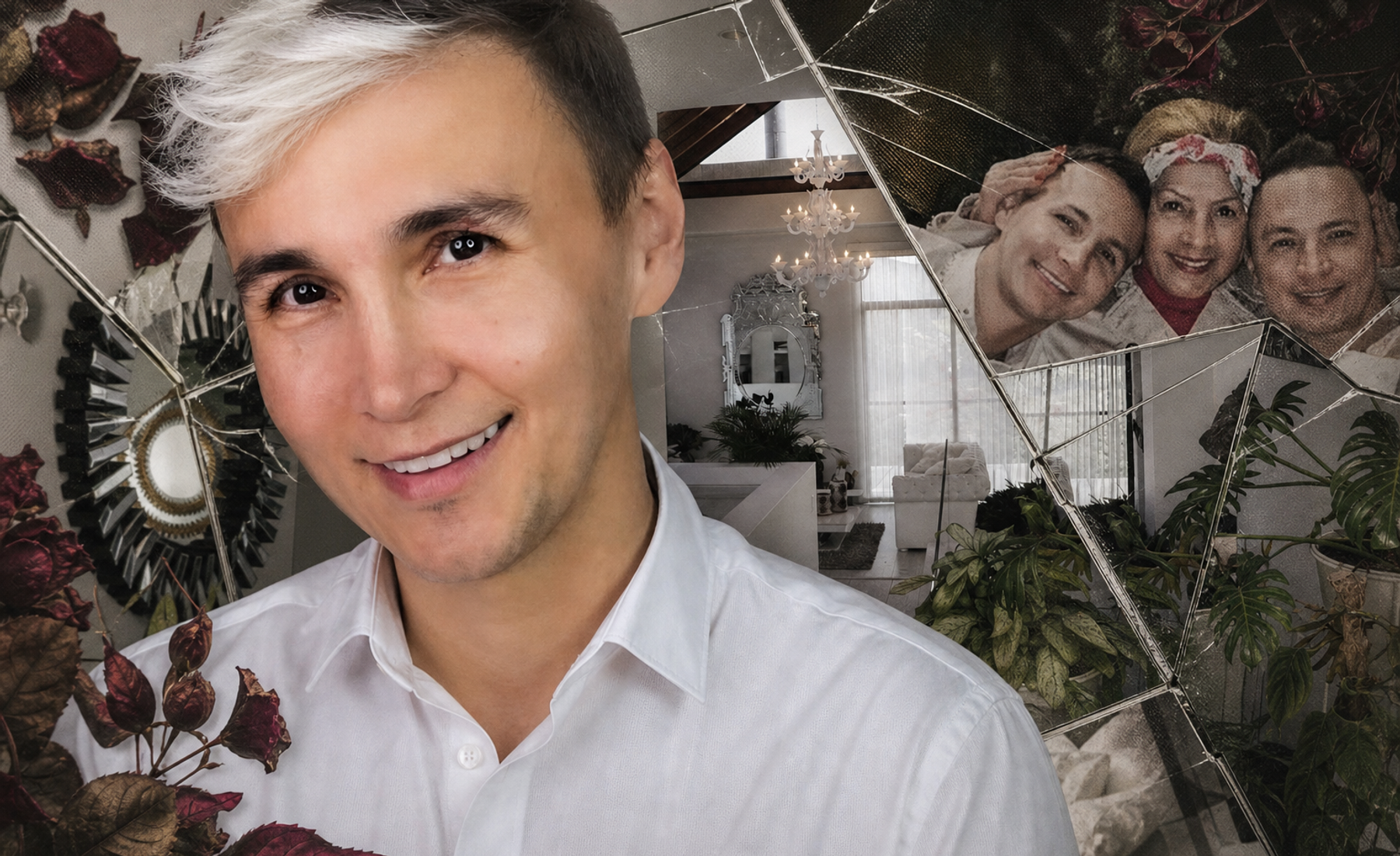


El Niño Genio
The news of the famous stylist's death spread quickly and plunged the Colombian public into shock. Mauricio Leal wasn't just any hairstylist – he was the hairstylist to the stars. He had risen from humble beginnings in Cali, starting out sweeping floors in salons, to eventually owning a high-end salon in Bogotá frequented by beauty queens, telenovela actresses, pop singers and TV presenters.
Friendly and soft-spoken, Mauricio was known for treating clients like family. He made regular appearances on TV style segments, always smiling and impeccably dressed, his own hair often dyed platinum blonde. By 2021 he had achieved national fame and was about to embark on international projects – he'd even been invited to collaborate on Miss Universe and a Victoria's Secret event.
For someone so successful and seemingly happy to be found dead under such tragic circumstances, fans and friends were baffled. Why would Mauricio kill his beloved mother Marleny and then himself? "It made no sense," one of his longtime clients said on a news broadcast, echoing what many were thinking.
In the days following the discovery, tearful tributes poured in from Colombian celebrities. They spoke of Mauricio's generosity and positive spirit. He had just been planning a big birthday celebration for himself – he would have turned 48 on November 24, 2021, just two days after his body was found.
Nothing in his recent behavior hinted at suicidal depression or violence. If anything, Mauricio seemed optimistic about the future.
Two Knives and a Broken Blade
As investigators from the Technical Investigation Corps of the Attorney General's Office began examining the gruesome scene inside the La Calera home, a few details immediately raised red flags. "We have a double homicide until proven otherwise," one detective quietly remarked to a colleague, unconvinced by the murder-suicide note. For one thing, the manner of death was highly unusual for a suicide.
Mauricio had multiple stab wounds, including a deep knife wound to his abdomen – almost like a bizarre attempt at seppuku, the Japanese ritual suicide, which is virtually unheard of in Colombia . It seemed implausible that a man would stab himself to death in such a manner, especially after supposedly stabbing his own mother first. The position of the bodies also felt too "neat." Marleny's body was lying peacefully beside her son's, as if placed there deliberately.
There was surprisingly little blood on the bed under Marleny, even though she had been stabbed, which was strange. Meanwhile, Mauricio's side of the bed was soaked with blood, far more than his mother's. This inconsistency hinted that Marleny might not have been killed on that spot at all.
And then there was the knife – or rather, knives. Investigators recovered not one but two bloodied kitchen knives from the room. The first knife's blade had broken off inside Mauricio's body, and its handle was found hidden under a pillow, intentionally tucked out of sight.
The second knife was found on the bed as well. If Mauricio had truly been the assailant and then committed suicide, why would there be two knives? Would he have stabbed himself so forcefully that the blade broke, then calmly gone to get another knife to finish the job?
That scenario made little sense. An experienced prosecutor on the scene flatly stated, "It's impossible that Mauricio, with a knife blade stuck in him, went down to the kitchen to grab another knife". The evidence was contradicting the simplistic murder-suicide theory.
The Autopsy Doesn't Lie
Police sealed off the house as a crime scene, and forensic teams scoured each room for clues. Over the next hours and days, more evidence emerged that this was no open-and-shut suicide case.
The autopsies provided a clearer timeline: the medical examiner concluded that both Mauricio and Marleny had been dead for approximately 30 to 36 hours by the time they were discovered on the afternoon of November 22, 2021.
That placed their time of death somewhere in the early hours of November 21 – well before the time Jhonier Leal said he last saw them alive. In his initial statement, Jhonier had told police that he'd had breakfast with his mother and brother on the 21st and then left them doing fine. If the autopsy was correct, that was a lie – by breakfast time on the 21st, they had likely already been dead.
The autopsy on Mauricio also found traces of a powerful sedative in his system: Zopiclone, a prescription sleeping pill . It appeared Mauricio had been drugged before his death, which could explain why there were no signs of struggle and why he might have been physically unable to defend himself or escape. Zopiclone would have made him extremely drowsy, perhaps even unconscious, at the time he was attacked.
That finding was critical – if Mauricio had been heavily sedated, he could not have possibly murdered his mother and then energetically stabbed himself multiple times.
Instead, it suggested he was the victim of a calculated plan. Investigators now theorized that the killer had slipped Mauricio a dose of sleeping medication to render him defenseless ("en estado de indefensión," as the report later put it ), then staged the scene to pin the blame on him.
The handwritten note found by the bed was another piece of the puzzle. Handwriting experts would later confirm that the note was indeed written by Mauricio, but likely under duress – the phrasing and scrawl suggested he was terrified and not writing of his own free will. Everything pointed to an elaborate cover-up.
The Shadow Brother
Suspicion quickly began to center on the only other person known to have been in the house around that time: Jhonier Rodolfo Leal Hernández, Mauricio's 49-year-old brother. Jhonier lived with Mauricio and their mother in the same house. In fact, his bedroom was just down the hall from Mauricio's.
From the outset, Jhonier was both a witness and a potential suspect, simply by virtue of proximity – statistically, police know that when a family is murdered, a relative in the home is often involved. But in those first days, no one wanted to believe that possibility. By all appearances, Jhonier was the grieving brother.
He attended the joint funeral of Mauricio and Marleny, sobbing inconsolably in front of TV cameras. In an exclusive interview with El Tiempo newspaper just days after the bodies were found, Jhonier spoke in a voice trembling with emotion: "We're still in shock, we're destroyed. We're waiting for the authorities to tell us what happened… My brother was an angel", he said, praising Mauricio's legacy and promising to keep his salon business running.
To the public, Jhonier presented himself as a heartbroken man who had lost his beloved younger brother and mother at the same time.
But behind the scenes, investigators noted unsettling behavior from Jhonier. One detective described Jhonier's demeanor in those initial interviews as oddly detached – "a lack of emotional connection to the deaths," as the detective put it.
While other relatives were hysterical with grief, Jhonier seemed preoccupied and jittery.
He changed details in his story, and certain things he said didn't line up with the evidence. For instance, he insisted that when he and the driver arrived on the 22nd, he had not climbed in through any window – the insinuation bothered him greatly, and he was eager to correct the record on that point. It struck investigators as peculiar that he cared so much about denying that minor detail to the press.
Why was he so defensive about how they entered the house? Perhaps, the police thought, because Jhonier knew any hint that he'd entered earlier (say, to commit the murders) could look bad for him.
It wasn't just the forensic evidence that pointed toward Jhonier; the circumstantial evidence of motive was growing too. As the investigation dug into the Leal family's background, a stark contrast between the two brothers emerged. Mauricio had been the family's shining star – successful, generous, and the primary breadwinner supporting his mother.
Jhonier, one year older, had led a much more troubled life. He was a hairdresser as well, always in Mauricio's shadow. In fact, it was Mauricio who had brought Jhonier to Bogotá and given him a job at the salon, trying to help his brother find steady footing.
But unlike Mauricio's booming business, Jhonier's own ventures had all failed . He struggled financially, had debts, and reportedly even had a history of gambling and personal problems, though those details were mostly whispered among those who knew the family.
Meanwhile, Mauricio, who was single with no children, had amassed a considerable fortune by Colombian standards – a beautiful house, a luxury SUV, high-end salon equipment, and hundreds of thousands of dollars in his bank accounts.
In the wake of the deaths, attention turned to what would happen with Mauricio's estate. Because he died without a spouse or kids, his nearest heirs were his siblings. And wouldn't you know it – the supposed suicide note explicitly said, "I leave everything to my siblings and cousins".
To investigators, that line in the note practically screamed motive. The main person standing to benefit from Mauricio and Marleny's deaths was Jhonier.
Tears for the Cameras
On January 14, 2022, almost eight weeks after the murders, the Colombian Attorney General's office made its move: Jhonier Leal was arrested and formally charged with the aggravated homicides of his mother and brother . When the Tactical Unit officers showed up to arrest him at dawn, Jhonier appeared strangely unsurprised. In fact, as they searched his home, they found something rather telling – Jhonier had in his possession bank account numbers, property titles and other documents belonging to Mauricio, which he had set aside as if preparing to inherit everything.
It seemed he was already calculating how to take over his late brother's fortune. The authorities knew they had the right man, but they also knew this would be a complex case to prosecute – it relied heavily on forensic evidence and would be fought in the courts, likely with fierce resistance from Jhonier.
Sunday Night at House #18
At Jhonier's first court appearance in Bogotá, prosecutor Mario Burgos presented a chilling reconstruction of the crime. Over the course of hours of testimony, Burgos laid out the prosecution's theory detail by detail, calling it "an act of pure greed and cruelty." According to the evidence, on the night of November 21, 2021, Jhonier put into motion a plan he had likely contemplated for weeks.
That Sunday, security camera footage from the exclusive Arboretto residential complex showed the comings and goings of the Leal family: Mauricio, Marleny, and Jhonier were home together through most of the weekend .
Around 6:13 p.m. Sunday, Jhonier left to attend a family gathering elsewhere, giving him an alibi for the early part of the evening . While at that gathering, he even received an innocent voice message from Mauricio asking him to pick up some cookies on the way home.
Nothing seemed amiss. At 11:37 p.m., cameras captured Jhonier re-entering the gated community and returning to House #18, the Leal home . Prosecutor Burgos asserted that sometime between roughly midnight and the early morning hours of November 22, Jhonier carried out the meticulously staged double murder.
The sequence of events, as presented by the prosecution and forensic findings, was as follows: First, Jhonier likely slipped a dose of sedative into Mauricio's food or drink on Sunday night, ensuring his brother would be in a deep sleep. Marleny, the mother, had her own bedroom on the third floor of the house . Jhonier entered her room first, perhaps while she slept, and attacked the 67-year-old woman with a kitchen knife.
Marleny had virtually no chance – she was smaller and older, and if she was asleep, she was taken completely by surprise. The evidence indicated Marleny was stabbed multiple times and died in her bed on the third floor . Her injuries were severe and immediately fatal.
Next, Jhonier moved to the second floor where Mauricio's master bedroom was. Drugged with Zopiclone, Mauricio was likely groggy and confused, but he woke to a nightmare: his own brother looming over him with a knife. Investigators believe Jhonier began attacking Mauricio with the same knife, delivering at least four serious stab wounds.
Mauricio, though a healthy adult man, was incapacitated by the drug and the shock of the assault. He suffered puncture wounds to his torso, arms, and even his nose – injuries that suggested a violent struggle and an attempt by the killer to subdue him into compliance . The forensic team later noted that Mauricio was right-handed, yet the angle and direction of many wounds indicated they were inflicted by a left-handed attacker.
(This was significant because Jhonier, according to people who knew him, was left-handed – a subtle but incriminating detail .)
At some point during this attack, the blade of the knife actually broke off inside Mauricio's body, lodging into his internal organs . Mauricio was gravely wounded but possibly still alive at that moment. Jhonier needed another knife to finish what he started.
So he left the room, leaving the broken blade impaled in his brother, and hurried to the kitchen to grab a second knife . He returned and continued his horrific task. Under threat and in agony, Mauricio was forced to do something unimaginable – write his own suicide notes.
Investigators found not one but two handwritten letters at the scene. It appears the first may have been a draft and the second the final copy. In these notes (essentially the same message repeated), Mauricio purportedly confessed to murdering his mother and begged forgiveness.
Prosecutor Burgos later explained that Jhonier held Mauricio at knifepoint, coercing him to pen those words as a way to divert suspicion. Handwriting analysis and other evidence showed Mauricio's writing was shaky and inconsistent by that time, likely due to blood loss and the sedatives – he was in a "state of helplessness" as he complied with his brother's demands.
Once the notes were written and signed, Jhonier delivered the final blows to Mauricio, ending his life.
Staging the Scene
Now came the staging. Jhonier retrieved their mother's lifeless body from the third-floor bedroom and carried or dragged her down to the second-floor master bedroom.
In doing so, he left a small but damning trail: a smear of Marleny's blood on the staircase, and another drop on a towel later found in Jhonier's bathroom. He placed Marleny's body neatly on the bed next to Mauricio's, perhaps even tucking her in somewhat. He positioned the suicide note prominently where police couldn't miss it.
He scattered a few pill containers around, maybe to hint that Mauricio had taken something (or to explain the presence of the sedative in his system). He also made a crucial mistake here: the bed where he laid Marleny had clean sheets on her side, with no blood, inconsistent with someone who had been stabbed to death there . This later suggested that Jhonier had changed the bedding to hide blood from her actual death upstairs – an overly meticulous touch that investigators noticed.
After arranging the bodies, Jhonier set about destroying evidence of his involvement. He tried to wipe away bloodstains and other traces. In the bathroom that Jhonier used, investigators later discovered a drain (sifón) with traces of blood, as if someone had been washing off gore.
They also found a mop (trapero) with bloodstains abandoned out on Jhonier's balcony, which was very unusual – the family's maid testified that mop was normally kept in a downstairs closet, yet now it was found near Jhonier's rooms, indicating it had been used and left there during cleanup . Cleaning liquids and bleach were found in odd places too, basically confirming that someone had tried to scrub the crime scene clean. In fact, the forensic team noted the smell of disinfectant still lingering.
During the later trial, the prosecutor summed it up: "Jhonier cleaned up with a mop and cleaning fluids. In his rush to construct his lie, he removed a corpse, changed sheets, and attempted to leave a perfect scene".
One of the most eerie pieces of evidence came from Mauricio's own iPhone. Investigators discovered audio voice notes recorded on the phone, seemingly messages from Mauricio to his family, in which he "confessed" to killing his mother and said he was going to end his life. At first glance, these recordings sounded like a man overcome with guilt – except for the timing.
The timestamps on the audio files showed they were created after Mauricio was already dead. More sophisticated analysis revealed that the voice in those recordings wasn't actually Mauricio's at all – it was Jhonier impersonating his brother, or perhaps speaking under his breath, trying to fabricate yet more "proof" of the staged scenario.
It appears that during the frenzy of covering up, Jhonier grabbed Mauricio's phone and recorded these voice notes, intending for authorities to find them and conclude Mauricio had confessed.
If this sounds like overkill, it was – but it illustrates how far Jhonier went to try to fool everyone. In fact, a video clip eventually surfaced that is almost too disturbing to believe: a short video of Mauricio's final moments, recorded on that phone's camera . In the video, a weak and pale Mauricio is seen propped up in bed next to his mother's inert body.
He addresses the camera haltingly, saying, "Forgive me. I can't anymore… Nobody knows what anyone's going through," seemingly taking the blame. A whispered voice off-camera prompts him – you can hear someone say "Las sábanas" ("the sheets") quietly, as if giving instructions . Mauricio then pulls down the blanket covering him to reveal his T-shirt, soaked in blood around his stomach.
"I just stuck the knives in myself, and my mom too," he says weakly on the video . In his final breathless line, Mauricio looks upward, as if at the person holding the camera, and asks plaintively, "Now what do I do? What do I do?" The video then cuts off. It's a harrowing visual record of the coercion and staged nature of the crime.
This video was not actually released to the public until years later, in 2024, causing national outrage when people saw the extent of manipulation Mauricio endured. But authorities have indicated they were aware of its contents during the investigation . The existence of the video (and the audio notes) underscores just how calculating Jhonier was in trying to frame his dead brother.
After completing the staging and cleanup in the morning of November 22, Jhonier stepped back to survey the scene. He had placed the second knife (the one he fetched from the kitchen) in Mauricio's lifeless hand or nearby, to make it look self-inflicted. The first knife's blade remained in Mauricio's abdomen, but its handle was hidden under a pillow – perhaps an oversight in the heat of the moment.
With everything arranged, Jhonier left the house. Security cameras captured him driving away from the compound at around 11:15 a.m. on the 22nd .
Presumably he went somewhere to dispose of any remaining evidence (maybe the missing bedsheets or bloody clothes) or simply to establish an alibi that he was out while the tragedy was "discovered." Not long after, he returned with the driver under the pretense of worrying about Mauricio's no-show at work, leading to the dramatic discovery that afternoon.
The case against Jhonier was overwhelming. By mid-January 2022, prosecutors publicly detailed all these findings in an audiencia de imputación de cargos (a preliminary charging hearing). The charges were aggravated homicide (with multiple aggravating factors: kinship, using a victim's defenseless state, and acting with cruelty) and obstruction of justice for the attempted cover-up.
'I Accept the Charges'
In that January 17, 2022 hearing, as the evidence was laid out, witnesses say Jhonier sat in the courtroom initially looking distracted, even bored . At one point the judge had to snap at him to pay attention. Only when the prosecutor spelled out the potential sentence he faced did Jhonier become visibly nervous.
The judge asked the prosecutor to clarify how many years in prison Jhonier was looking at if convicted. The answer came: approximately 43 years behind bars, possibly more . However, if Jhonier were to accept responsibility and plead guilty at that stage, Colombian law would allow a significant reduction – up to a 50% reduction of the sentence.
In other words, a plea deal could make his sentence around 20 to 27 years instead of 43 to 50 years.
When the court took a short recess, Jhonier huddled with his attorney to weigh his options . The evidence against him was ironclad; if he went to trial and lost, he'd likely spend the rest of his life in prison. A few minutes later, as the hearing resumed on January 18, 2022, Jhonier Leal made a surprise turnabout: he stood before the judge and the assembled press and confessed.
"I have taken the decision, freely and voluntarily, to accept the charges through an agreement with the Fiscalía," he said. In a tremulous voice, he continued, "I want to express my repentance, asking forgiveness, first of all, from my family and my children, the victims and all of Colombia for what happened". This statement was broadcast live and stunned those watching.
Many Colombians had been following the case and still wondered if perhaps Mauricio had really done it; now here was Jhonier, the brother, dramatically admitting he was the killer. In his speech, he mentioned he had consulted with his lawyer and decided to take a "very personal" decision to accept responsibility. He even specifically asked forgiveness from his two young children – an emotional touch that some felt was calculated to garner sympathy.
This confession was a major twist in the saga. It appeared that justice would be swift: with his admission of guilt, all that remained was formal sentencing. Under the plea agreement reported at the time, Jhonier was supposed to receive a sentence of around 27 years in prison in exchange for accepting the charges.
For many, 27 years felt far too lenient for the brutal killing of two family members, but it was within the bounds of Colombian law due to his confession. However, the case was about to take another unexpected turn.
'I Am Innocent'
Just three months later, in April 2022, Jhonier astonished everyone by retracting his confession.
In an April 22 hearing before a different judge, Jhonier's new attorney – a high-profile defense lawyer named Ana Julieth Velásquez – declared that Jhonier wished to "renounce the pre-agreement" and plead not guilty.
Velásquez explained that she was Jhonier's attorney of choice but had not been present in January (back then, Jhonier had a public defender). Now that she was representing him, she advised that his rights had been violated.
According to her, Jhonier claimed he had been "coerced" into confessing by pressure from the prosecution. He allegedly believed he was going to get only 18 years if he confessed, but the written deal turned out to be 27 years. Feeling tricked, Jhonier decided to back out.
In court, his lawyer dramatically stated, "My client will not ask forgiveness for something he didn't do, and for a plea deal to which he was coerced" . She insisted that Jhonier was innocent and had only admitted guilt under duress.
The judge questioned Jhonier directly: was he now denying his earlier confession and rejecting the plea deal? Jhonier replied firmly, "Definitivamente no acepto los cargos, no acepto nada. Soy inocente." – "Definitely I do not accept the charges, I accept nothing. I am innocent." . And with that, the case was thrown back into a full trial posture.
Jhonier's attempt to withdraw his plea meant prosecutors had to prepare to prove his guilt all over again in a courtroom, despite the January confession being on record. Colombian legal procedure allows a defendant to retract a plea deal before final sentencing, and that's exactly what Jhonier did. Many observers were stunned – he was really going to fight this, despite the mountain of evidence.
Some speculated that Jhonier was playing a long game: by dragging out the trial, maybe he hoped for some evidence to be deemed inadmissible or for a procedural mistake that could benefit him. Or perhaps, given the high-profile nature of the case, he simply couldn't accept being labeled a murderer so publicly and wanted to salvage his name, however futile it seemed.
The Evidence Speaks
And so began a long, drawn-out judicial process. Over the next two years, the Mauricio Leal murder case wound its way through the Colombian justice system, with numerous hearings, appeals, and delays. Jhonier's defense team employed every strategy available to challenge the prosecution's case.
They filed motions claiming Jhonier's rights had been violated, arguing evidence was mishandled, and even lodged a tutela (a special constitutional appeal) asserting that Jhonier wasn't receiving a fair trial.
At one point, Jhonier himself complained to the trial judge that he did not have the necessary guarantees to mount his defense and that his rights were being infringed . These claims, however, did not find much traction.
Despite the defense's efforts, the core evidence remained unshakeable. The forensic findings – the blood traces, the fingerprints, the CCTV footage, the handwriting analysis, the audio recordings – all pointed squarely to Jhonier. The prosecutors presented expert after expert who systematically dismantled the notion of a murder-suicide and tied the crimes to Jhonier.
For example, DNA analysis showed that a strand of hair found clutched on Marleny's body matched Jhonier, suggesting a struggle or physical contact during her killing . Blood from Marleny was found on a towel in Jhonier's bathroom, and a drop on the staircase matched her blood as well. The broken knife handle under the pillow had Jhonier's fingerprints.
It was also revealed that in the days following the murders – before his arrest – Jhonier had made some suspicious financial moves. He attempted to withdraw large sums from Mauricio's business accounts and contacted a lawyer about claiming his brother's assets, which looked very incriminating when brought up in court.
Throughout the trial, the prosecution maintained a clear motive: money. In closing arguments, a state attorney bluntly declared, "The murderer is Jhonier Leal Hernández," and accused him of killing for "the fortune of the niño genio, the stylist to the famous". Indeed, Mauricio's sizable estate was effectively frozen after his death, pending investigation.
(In a parallel civil process, the government's financial crimes unit was pursuing the seizure of Mauricio's assets, partly because some of his money was suspected to be tied to money laundering for drug traffickers – an unrelated twist that nonetheless meant Jhonier might never get that fortune even if he had gotten away with murder.) So, not only had Jhonier destroyed his family, but the very prize he sought was slipping away.
One poignant moment during the trial came from the testimony of a family friend, Karen Ruiz, who had helped organize what was supposed to be Mauricio's birthday party just days after he died. She revealed a telling detail: Marleny, the mother, had explicitly told her that she did not want Jhonier invited to Mauricio's birthday celebration.
Karen testified that when she was going over the guest list with Marleny, suggesting they include Jhonier since he was Mauricio's brother, Marleny replied emphatically, "No, not at all – under no circumstances," using a tone that shocked Karen.
This suggested that Marleny and Mauricio might have been growing wary of Jhonier in the weeks leading up to the crime. Perhaps Marleny had sensed something was off with her eldest son – maybe a brewing resentment or erratic behavior – and she didn't even want him at a family party. This bit of testimony added a heartbreaking layer to the family dynamic: Marleny seemingly feared discord or trouble if Jhonier was around, but no one imagined he would go to such lengths.
It also undercut any notion by the defense that relations were peachy or that Jhonier was the dutiful son. In fact, much of the testimony painted Jhonier as increasingly bitter and jealous. Witnesses described how Mauricio's success ate at Jhonier.
One salon employee recounted how Jhonier would make snide remarks like "must be nice to be the favorite" when Mauricio got praise. Another witness said Jhonier had asked, half-jokingly, how much one could get by selling a luxury salon chair – hints that he was eyeing the business valuables. All of this helped the prosecution narrate a story of a man consumed by envy and greed.
55 Years
After two years of legal battling, justice caught up with Jhonier Leal. In late 2023, the trial finally concluded. On February 27, 2024, a judge in Bogotá delivered the verdict: Guilty on all counts.
The judge found that the Fiscalía (prosecutor's office) had proven beyond any reasonable doubt that Jhonier had murdered his mother and brother with cruelty ("sevicia") while they were in a defenseless state, and had staged the scene to mislead investigators. Hearing the verdict, Jhonier showed little emotion at first. But when it came time to discuss the upcoming sentence, he finally spoke up.
He addressed the court, still insisting on his innocence despite the guilty verdict. "Señora Juez, I obviously do not agree with the verdict. I will always proclaim my innocence," Jhonier said defiantly. He went on to say that what the prosecution sought – effectively a life term – was akin to a death sentence for him.
"At my age, a sentence like that is practically a death sentence – it means never leaving prison," he remarked to the judge, perhaps in a last-ditch plea for leniency. Indeed, at 50 years old, any sentence approaching half a century would ensure he dies behind bars. But the judge and the public had little sympathy left for Jhonier.
A few months later, on June 14, 2024, Jhonier Leal's sentence was announced. He received 55 years and 3 months in prison, one of the harshest penalties in recent Colombian history for a case of this kind. The judge in charge heeded the prosecution's request for the maximum penalty.
Additionally, Jhonier was fined the equivalent of about $1 million USD for the damage caused and for the crime of tampering with evidence. In Colombian legal context, 55 years is an extraordinarily long sentence – the country has no official life sentence, but this term is effectively life for Jhonier. He will be well over 100 years old by the time his sentence ends, with no possibility of early release under the terms given.
Jhonier was sent to La Picota prison in Bogotá, a facility known for housing some of Colombia's high-profile criminals. Outside the courthouse, crowds gathered during the sentencing hearing broke into applause at the news. Many held photos of Mauricio Leal or signs that read "Justicia para Mauricio y Marleny." The case had captured national attention for over two years, and the public overwhelmingly saw Jhonier as a cold-blooded villain.
The Leal family's remaining relatives – including a younger half-brother of the Leal brothers and Marleny's siblings – expressed relief that it was over. In media interviews, an aunt of Mauricio's tearfully called Jhonier "a monster", lamenting that greed had destroyed their family.
To this day, Jhonier Leal maintains that he is innocent and that the truth "has not come out." He has filed appeals, though legal experts doubt any will succeed given the thoroughness of the trial. The overwhelming physical evidence and his own initial confession form a virtually inescapable web of guilt. It's worth noting that by backing out of the plea deal, Jhonier not only doubled his prison time but also forfeited any goodwill.
The judge specifically cited his lack of remorse and the egregious betrayal of family trust as reasons for the stiff sentence. As one prosecutor put it, "He had a chance to seek forgiveness and leniency, and he threw it away. Now he faces the full weight of justice."
The Stylist's Legacy
In the aftermath of the case, many in Colombia were left reflecting on the dark irony of it all. Mauricio Leal spent his life bringing beauty and confidence to others – he could transform a client's look with a few snips and brushes, earning him fame and love. He was, by all accounts, a kind-hearted man who took care of his mother and tried to help his siblings.
Yet, ultimately, he was betrayed by the very brother he had supported. It's a story that resonated because it was both a celebrity crime saga and an intimate family tragedy. "Appearances can be deceiving," one news commentator remarked, noting how even as Mauricio smiled on magazine covers, deadly tensions were brewing at home unbeknownst to the public.
The case also spurred discussions in Colombia about mental health, greed, and justice. Could anything have prevented this, people wondered – did Jhonier ever seek help, did Mauricio ever suspect his brother capable of harm? Those questions may never have clear answers.
For now, Jhonier Leal will spend the rest of his life in prison, waking up each day far from the luxury and celebrity circles he once envied. Mauricio's salon in Bogotá was shuttered in the wake of the murders – its staff left unemployed, its clientele heartbroken.
The property and assets of Mauricio Leal were taken over by Colombia's authorities, and some have been earmarked to be auctioned or repurposed, given the ongoing investigation into the financial side of his business.
As for the memory of Mauricio and Marleny, they are mourned not only by family and friends, but by ordinary Colombians who followed the case closely. In interviews, several of Mauricio's famous clients shared their memories of him: his warmth, his talent, the way he'd say "Divina, quedaste divina" ("Gorgeous, you look gorgeous") after finishing a hairstyle, making everyone feel like a star. That is how they choose to remember him – not the grim images from that crime scene or the macabre video that leaked, but the generous soul and creative genius he was in life.
The tragedy of Mauricio Leal and his mother Marleny Hernández is a cautionary tale about how greed can destroy even the closest of bonds. It's a story of a meticulously planned deception that unraveled under the scrutiny of determined investigators. In the end, the so-called "Stylist of the Stars" did not take his own life in a moment of madness – his life was stolen from him by someone he should have been able to trust.
And thanks to a relentless pursuit of the truth, that someone – his own brother – will pay for that betrayal behind bars for decades to come.
Primary reporting and references
- El asesinato de un reconocido estilista y su madre que conmociona a Colombia
KTVZ/CNN en EspañolJan 18, 2022
- The Mysterious Death of Colombia's Celebrity Hairstylist
El País EnglishJan 18, 2022
- Jhonier Leal and the plan he had to frame another person in the murder of Mauricio and Marleny
Infobae EnglishApr 06, 2022
- Jhonier Leal fue condenado a 55 años de prisión por crimen de Mauricio Leal y su madre
W Radio ColombiaJun 14, 2024
- It was a devastating investigative work, said Attorney General about the clarification of murders of the stylist Mauricio Leal Hernández and his mother
Fiscalía General de ColombiaJan 20, 2022
- Jhonier Leal se queda sin testimonio de perito forense
Related episodes
Serial Killer Cop Preys on Her Own Relatives
A police sergeant murders relatives for insurance money to fund her gambling and lifestyle.
The Black Widower
A woman's death exposes an 18-year insurance murder scheme inside her own family.
The Attorney From Hell
A staged narco execution collapses when the sole survivor reveals a darker family plot.